

Gas Fireplace Guide: Types, Costs, Safety and Common Problems
Compare gas fireplace types, fuel and venting options, useful heat output and project costs. Learn what to ask before buying, which owner checks your manual may allow, and when to stop and call a professional.
On this page
Gas Fireplaces · Buying & ownership guide
A gas fireplace burns natural gas or propane to make real flames, without storing firewood or clearing wood ash. Before choosing one, compare the fuel supply, venting system, useful heat output and installation requirements—not just the width of the flame.
This guide explains the main types, the questions to ask about costs and sizing, and the owner care your manual may allow. It also explains when an operating problem needs professional service rather than another lighting attempt.
Important: this is general buying and ownership information, not a gas installation or repair manual. The instructions and approvals for your exact model, together with local professional requirements, govern the project. For a suspected gas leak or CO emergency, follow the emergency guidance below.
What is a gas fireplace and how does it work?
A gas fireplace is a firebox with a gas burner inside. It burns natural gas from a utility line, or propane from a tank, instead of wood. Ceramic logs, stones or glass media sit on or around the burner. Real flames play over them, and the logs glow much as a wood fire would.
How does a gas fireplace work, step by step?
- Gas supply. A gas line runs to the fireplace from your home’s natural gas supply or from a propane tank. A shut-off valve is fitted near the unit.
- Ignition. A small pilot flame or an electronic igniter lights the gas at the burner.
- Combustion. Gas mixes with air and burns, producing flame and heat.
- Heat transfer. Heat reaches the room as radiant heat through the glass, which you feel on your skin when you can see the flame. It also reaches the room as convection, as air warms in channels around the firebox. Many units add a blower to push more warm air into the room.
- Exhaust. In vented models, combustion products leave the house through a vent or chimney. These are mainly water vapor and carbon dioxide, plus small amounts of other gases. Vent-free models release them into the room, which is why they carry extra rules.
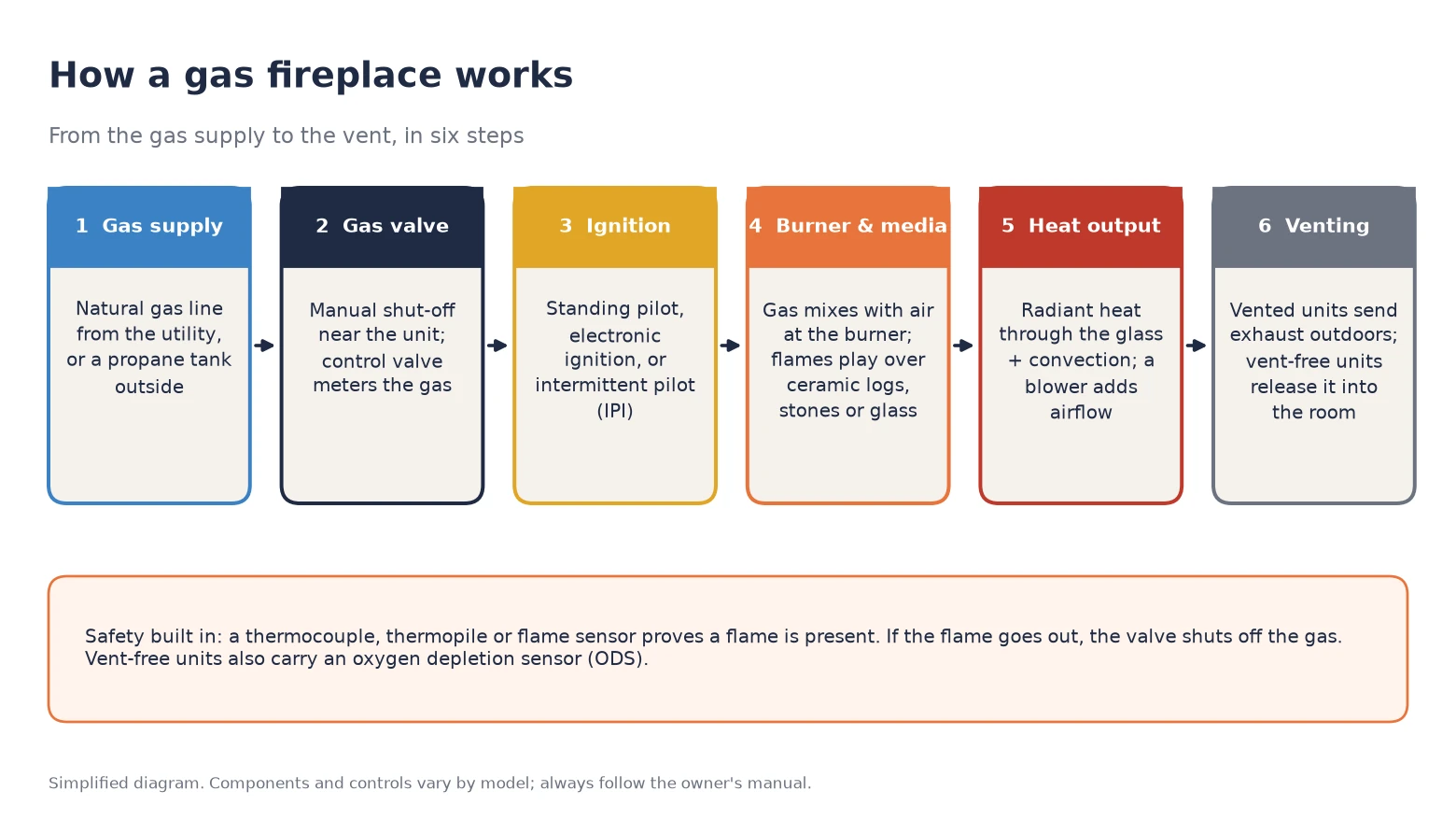
Most of the work is done by four main components:
- Burner. This is where the gas burns. Its design shapes the flame pattern and the heat output.
- Ignition system. This is a standing pilot, an electronic ignition or an intermittent pilot. Each is explained below.
- Gas valve and safety sensors. A thermocouple or thermopile, or an electronic flame sensor, confirms that a flame is present. If the flame goes out, the gas is shut off.
- Media and glass. Logs, stones or glass beads give the look. The sealed glass front, on direct vent units, keeps combustion separate from your room air.
Types of gas fireplaces: inserts, built-ins, freestanding, log sets and outdoor
People say “gas fireplace” to mean several different kinds of product. Work out which one you need before you compare prices, because the installation work differs a great deal from one to the next.
Gas fireplace inserts
An insert is a self-contained steel or cast-iron firebox. It slides into an existing wood-burning fireplace and turns it into a gas fireplace. Inserts normally run a new vent liner up the old chimney. For most homeowners, this is the usual way to convert a wood fireplace to gas.
- Consider for: homes with an existing masonry or factory-built fireplace that is drafty, messy or seldom used.
- Check: whether the insert suits your opening and your chimney. A factory-built (prefabricated) wood fireplace may only accept inserts approved for that unit.
Built-in (zero-clearance) gas fireplaces
Built-in units, also called zero-clearance fireplaces, have an insulated outer shell. That shell allows them to be framed into a wall, as long as the clearances in the manual are kept. No existing chimney is needed. They are usually direct vent, venting through a side wall or the roof.
- Consider for: new builds, renovations, feature walls, and linear “ribbon of fire” designs.
- Styles: front-facing, linear, corner, two-sided see-through, three-sided peninsula, and flush or recessed fronts.
Freestanding gas stoves
These look like a traditional wood stove but run on gas. They stand out from the wall, which can make them an option where a built-in fireplace would not suit the room. Location still depends on the approved vent route, supporting surface, gas supply and all model-specific clearances.
- Consider for: rooms without an existing fireplace, where the installation manual permits the proposed location.
Wall-mounted and compact units
Some slim direct vent models hang on, or recess partly into, a wall. They suit rooms where floor space is tight. Like every gas appliance, they still need a gas line and venting that suits the model.
Gas log sets
A gas log set is a burner with decorative logs for an approved fireplace. Vented and unvented sets have different installation and operating requirements; they are not interchangeable. An open, vented log installation may be mainly decorative rather than an effective room heater. Ask the installer about approved fireplace compatibility, damper requirements and useful heat output before comparing it with a gas insert.
Outdoor gas fireplaces and fire features
Outdoor fireplaces, fire tables and fire pits bring a flame to a patio or deck. Use only units rated and approved for outdoor use, and follow the clearances to roofs, walls and plants.
Design styles and media
- Traditional: realistic log sets and glowing embers, often with a brick-pattern liner.
- Contemporary: wide linear fireboxes with glass beads, stones or driftwood-style media, often with reflective black liners.
- Transitional: a mix of the two, such as glass media with a few log accents.
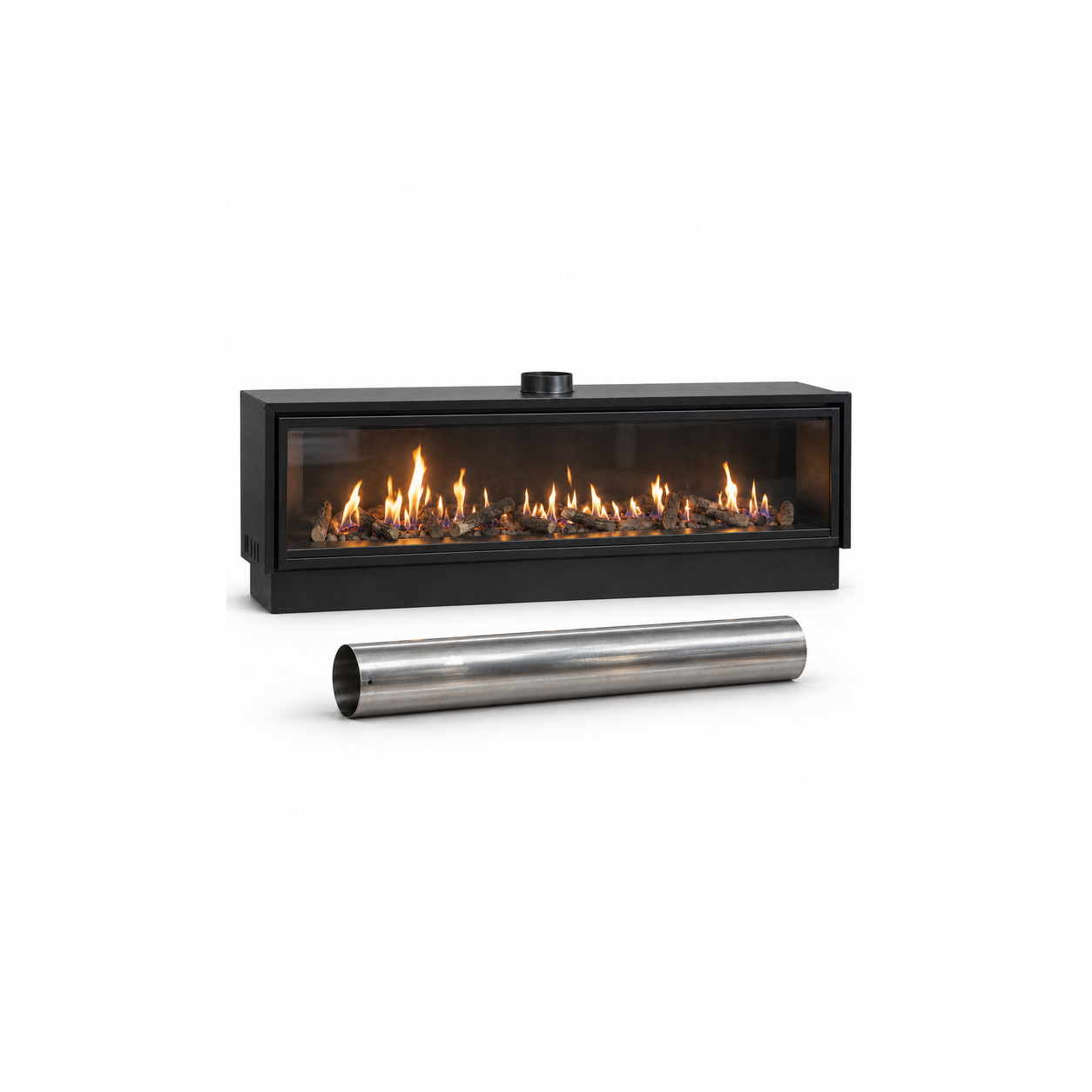
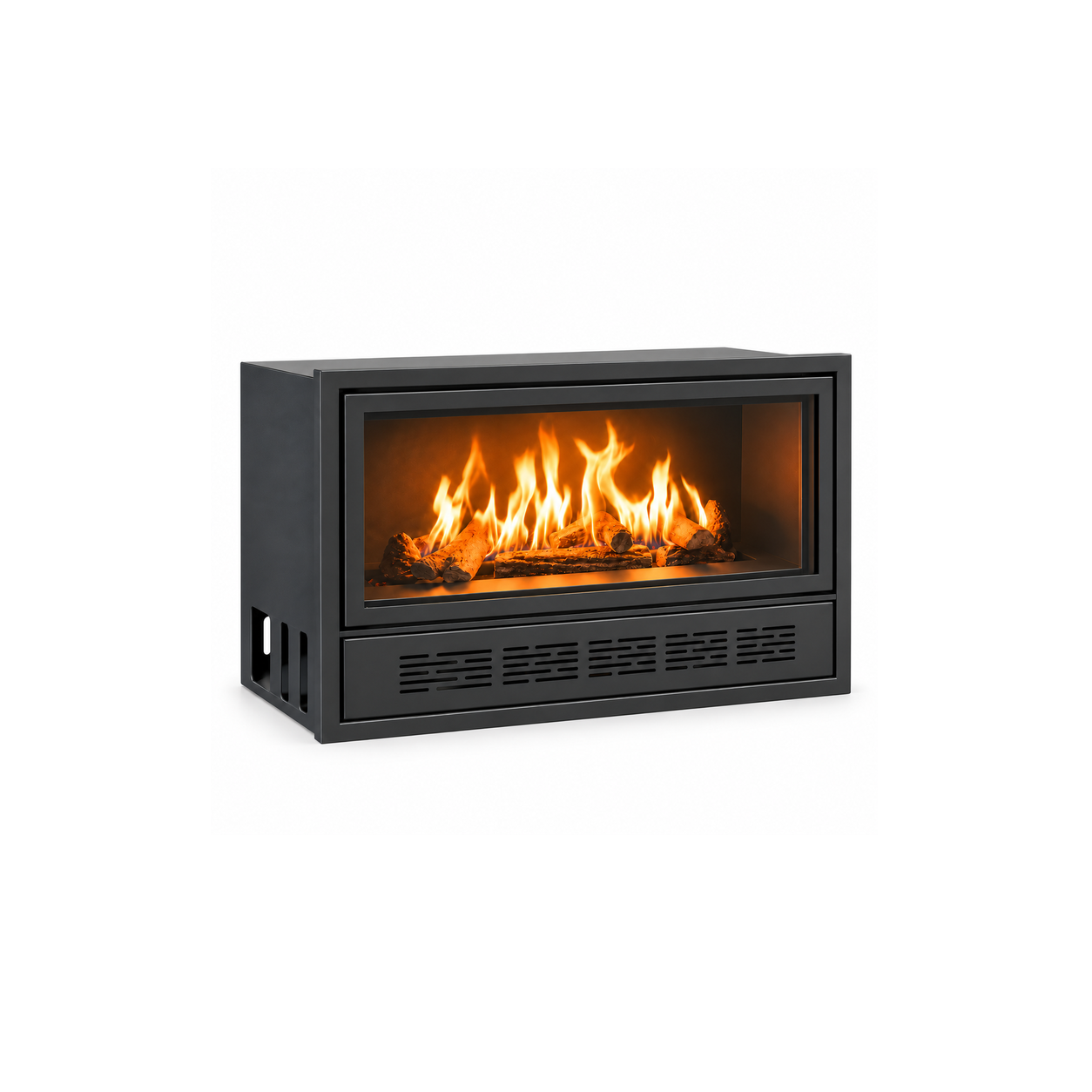
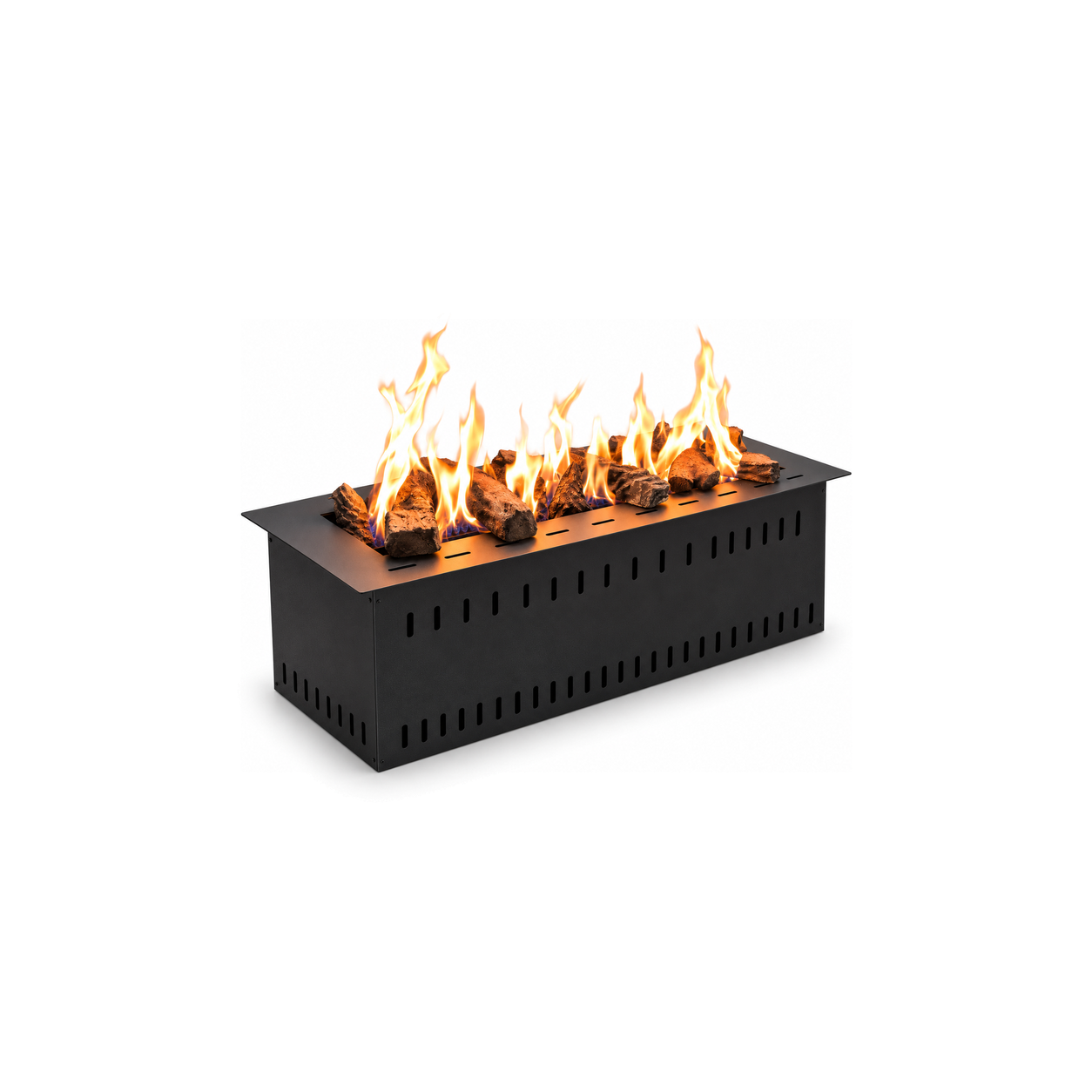
If you are comparing looks, the current SXFireplace gas fireplace range includes the SXRX-C-001 Wide Black Gas Fireplace, the SXRX-C-001-900 Black Framed Gas Fireplace and the SXRX-C-002 Open-Top Gas Fireplace Burner. The images below are AI-assisted appearance references, not installation photographs. Confirm the exact fuel configuration, heat ratings, venting category, local approvals and included components in writing before specifying any model; appearance alone establishes none of these.
Direct vent vs B-vent vs vent-free: venting explained
Venting is the single biggest decision you will make, because it affects safety, efficiency, where the fireplace can go and what it costs to install.
Direct vent (sealed combustion)
Direct-vent appliances draw combustion air from outdoors and discharge exhaust outdoors through a manufacturer-approved system. Depending on the model, that may use coaxial pipe or separate co-linear liners. A correctly installed and maintained sealed-combustion system is designed to separate combustion from room air; it does not eliminate the need for maintenance or CO alarms.
- Why compare it: it can provide an outdoor combustion-air supply and a choice of approved vent routes. Wall, roof and power-vent options depend on the particular model.
- Watch for: the full approved vent layout and terminal clearances to openings, walkways and other obstructions—not just whether a pipe can reach an outside wall.
For an example of why pipe designs differ, see Valor’s model-specific co-linear vent instructions. They are an example, not instructions for an SXFireplace product.
B-vent (natural vent)
A natural-draft gas fireplace draws combustion air from the room and discharges exhaust through the approved vertical vent or chimney system. A Type-B gas vent is not interchangeable with a masonry chimney or every other gas-vent system.
- Why compare it: a traditional appearance or an existing suitable vertical route may suit the project.
- Watch for: room-air supply and pressure conditions. Extractor fans and building changes can affect draft. The installer must check the exact appliance and vent requirements and assess the risk of combustion gases spilling into the room.
Vent-free (ventless)
Vent-free or ventless gas appliances have no exhaust vent, so combustion products and moisture enter the room. An oxygen-depletion safety device, where required for an approved appliance, is not a CO alarm and does not replace ventilation or proper installation.
Do not treat “no chimney” as permission to install one. Local availability, legality, room conditions and operating restrictions must be confirmed for the exact product. DOE/PNNL guidance recommends against unvented combustion appliances in conditioned living spaces because of combustion-product and moisture concerns. Do not use an unvented appliance while sleeping or leave it burning unattended.
Venting comparison table
Scroll across the table to see all columns.
| Feature | Direct vent | Natural draft / B-vent | Vent-free |
|---|---|---|---|
| Combustion air | Outdoor air through its approved system | Room air, subject to combustion-air requirements | Room air |
| Combustion exhaust | Outdoors via an approved terminal | Outdoors via the approved vertical vent or chimney | Released into the room |
| Key planning question | Does the complete approved vent route fit? | Are draft, combustion air and chimney/vent compatibility acceptable? | Is this exact use permitted, and what health and moisture risks remain? |
| Heat comparison | Use the specific model’s rating and test method | Use the specific model’s rating and test method | Do not equate retained heat with acceptable indoor air quality |
| Installation limit | Model instructions and local approval | Model instructions and local approval | Local approval may restrict or prohibit use |
Natural gas vs propane
Gas fireplaces are supplied in configurations for a specified fuel. A natural-gas unit is not automatically suitable for propane, or vice versa. Conversion is an option only if the manufacturer approves it and supplies the correct procedure or kit for a qualified gas professional.
Scroll across the table to see all columns.
| Question | Natural gas | Propane (LP) |
|---|---|---|
| Supply | Utility line, where available | Delivered to an approved storage tank |
| Project work | Confirm meter capacity, line sizing and any new connection | Confirm tank siting, regulation, line sizing and delivery arrangements |
| Running cost | Use the current local tariff and the configured input rate | Use the supplier’s current rate and energy unit |
| Power outage | Ignition, controls and blower capability are model-specific | A tank does not by itself make ignition or controls work without power |
| Combustion | Produces combustion byproducts; correct configuration, air and venting matter | Produces combustion byproducts; correct configuration, air and venting matter |
Compare cost per unit of energy, then consider useful heat delivered—not just fuel volume. If a propane tank runs empty or supply is interrupted, ask the supplier or qualified professional to check the system and restore service. Do not try to bleed air from a gas line. PERC explains propane supply and relighting precautions.
Heat output and sizing: what size gas fireplace do you need?
BTU input vs heat output
Fireplace specifications list an input rating in BTU per hour (Btu/h), which is the gas burned in an hour. Some also list an output, which is the heat actually delivered to the room. Output depends on input and efficiency. For a simplified hypothetical example, a 20,000 Btu/h fireplace running at 70% efficiency delivers about the same heat as a 40,000 Btu/h unit running at 35%, while using half the fuel. When you size a fireplace, compare output, not input.
Which heat ratings should you request?
A generic BTU range by fireplace style cannot tell you what will heat your room. Ask for the selected fuel configuration’s rated input, verified heat output, minimum operating rate and applicable test method. Confirm the heat load with the installer rather than choosing by width or a generic floor-area chart.
Bigger is not better
Avoid oversizing. A high-output fireplace in a small or well-insulated room overheats it, uses more gas than needed, and can push you to switch it off, so you lose the flame you paid for. To size sensibly:
- Decide whether you want ambience with some warmth or real zone heating of the main living area.
- Note the room’s floor area, ceiling height and insulation, how many windows it has, and how open it is to the rest of the house.
- Look for turndown (modulation), which lets you lower the flame and heat a long way. A wide turndown range keeps a room comfortable without the unit cycling on and off.
- Where heat would build up in one room, look at options that move it elsewhere, such as a blower, a ceiling fan, or ducting kits on some models.
- Ask the dealer or installer to explain why a given output suits your room. If you want the fireplace to cover a significant share of your heating, ask for a heat-loss calculation.
Efficiency ratings: what the numbers mean
Two fireplaces can advertise different efficiency percentages without having been tested the same way. Before comparing the numbers, ask which standard and operating condition produced each rating.
- Input describes fuel energy consumed; it is not the same as useful room heat.
- Steady-state efficiency describes a particular running condition. It does not by itself describe start-up, pilot use or a whole heating season.
- Fireplace Efficiency (FE) is used in Canada under a specified test method. Compare model-specific ratings measured to the same standard; do not treat FE, AFUE and an unspecified “efficiency” claim as interchangeable.
- Minimum output and control range matter if the room needs less heat than the appliance’s maximum output.
Natural Resources Canada explains regulated gas fireplace ratings, and its searchable product database can help verify listed Canadian-market models. A listing for another brand is not evidence of an SXFireplace rating or approval.
Ignition systems, controls and features
Ignition types
Scroll across the table to see all columns.
| System | What it means | What to confirm |
|---|---|---|
| Standing pilot / millivolt | A pilot remains alight while that mode is enabled | Pilot fuel use, permitted seasonal shutdown and power-outage operation |
| Electronic ignition, including IPI designs | An electronic system initiates ignition; an intermittent pilot lights when called for | Electrical supply, battery backup, permitted pilot modes and exact lighting instructions |
Names and control modes vary. An electronic system may also offer a continuous-pilot mode, so check the actual configuration rather than assuming no gas is used whenever the main burner is off.
Controls
- On/off wall switch: a straightforward user control where supplied.
- Remote control: from simple on/off to multifunction remotes covering flame height, blower speed, lights and timers.
- Thermostatic remote: switches the burner or modulates output according to the particular model’s control design.
- App or smart control: offered on some models.
- Manual valve or key: some older fireplaces and log sets use a gas key in a floor or wall valve.
Useful features
Features are model-specific. Confirm what is included and what is optional.
- Adjustable flame and heat: compare the usable control range, not only maximum input.
- Blower: may circulate room air around the appliance, but needs its specified power supply.
- Accent lighting: may operate independently of the flame on some models.
- Timers and shut-offs: use only as described by the manual; do not rely on a timer to make unattended use acceptable.
- Control lock: may reduce unintended operation, but does not replace supervision or keeping controls out of children’s reach.
- Protective barrier: use the manufacturer-approved barrier where required for hot-glass appliances.
Gas fireplace cost: buying, installing and running
Costs vary by location, fuel supply, appliance and building work. Compare written, itemized local quotations with the same scope. A headline installation total may already include some of the items below, so do not add overlapping totals and allowances.
Purchase and installation
Scroll across the table to see all columns.
| Quote item | What to ask |
|---|---|
| Appliance and accessories | Exact model, fuel configuration, trim, media, controls and optional components |
| Venting or chimney work | Approved components, liners, terminal, access, labor and making good |
| Gas supply | Capacity check, piping, regulation and any utility or tank work |
| Electrical work | Ignition, blower, lights and backup requirements |
| Framing and finishes | Approved materials, clearances, mantel/TV detailing and access for servicing |
| Permits and inspection | Who arranges and pays for each locally required step |
| Commissioning and handover | Testing, documentation and instruction in the exact model’s controls |
| Ongoing costs | Professional servicing, replacement parts, fuel and any electricity |
Check exclusions and taxes, and ask whether the quoted labor, materials and finishing are already included in a package total. We have not published generic price bands here because they are not a quotation for your country or project.
Running cost: how to estimate it yourself
Running cost depends on how much gas your fireplace burns, your local gas price and how many hours you use it. You can work out a rough figure yourself:
For natural gas billing, EIA defines one therm as 100,000 Btu. The example below is energy-use arithmetic, not a heating-coverage or price claim.
- Natural gas: 1 therm = 100,000 BTU. A fireplace burning 30,000 Btu/h uses about 0.3 therm per hour at full fire. Multiply that by your price per therm, or by the equivalent in your local unit.
- Propane: ask your supplier for the price and the energy content per unit they sell, and work it out the same way.
- Running on low flame or under thermostat control uses less than the full-fire rating.
- Remember the pilot. A standing pilot burns gas around the clock unless you switch it off.
Zone heating can change total household consumption, but savings depend on the fireplace’s efficiency, the main heating system, controls, weather and how the home is used. A new flame feature is not a guaranteed bill reduction. Include pilot gas, electricity, fixed supply charges and servicing when comparing ownership cost.
Installation: requirements, codes and the process
Can I install a gas fireplace myself?
Gas piping, combustion setup, venting and commissioning are not generic DIY tasks. Use an appropriately qualified—and locally licensed or registered where required—gas professional, following the exact manufacturer instructions and local requirements. Incorrect work can cause leaks, CO exposure or fire, and may affect warranty or insurance cover. HSE’s guidance for gas-appliance owners explains why competent installation and servicing matter.
Codes and standards you may hear about
The governing rules depend on your country, local authority, appliance category and the code edition adopted there. North American projects may refer to fuel-gas codes, relevant ANSI/CSA appliance standards, chimney provisions or Canada’s CSA B149.1. Those names are not evidence that any particular product has been certified.
Ask the installer and authority having jurisdiction to confirm the applicable requirements, permit and inspection process, and the selected model’s recognized listing. Obtain the actual documentation before specifying the opening, gas connection or vent.
Chimney height: the 2-10 rule
You may hear “2-10” or “3-2-10” when discussing a masonry chimney. It refers to chimney-height provisions in some building codes; it is not a universal formula for every gas vent or terminal.
Do not use a generic chimney drawing to set a direct-vent or Type-B termination. The appliance instructions, approved vent-system instructions and locally adopted rules govern the project. An installer converting an existing fireplace must check whether the chimney, liner and termination are suitable for the particular insert.
What the installer will plan before installation
- Location: where you sit, where heat is needed, how heat moves to other rooms, and clearances to furniture, curtains and mantels.
- Venting route: through the wall or the roof, the length, and where the terminal goes.
- Gas supply: the route from the meter or tank, and the pipe size.
- Electrical supply: for blowers, electronic ignition or lights.
- Framing and finishing: combustible and non-combustible zones, and mantel heights from the manual.
What installation involves
- Insert: the installer prepares the old firebox and runs a vent liner up the chimney. They connect gas, and electricity if needed, set the insert in place, cap the chimney and test the system.
- New built-in fireplace: the installer frames an enclosure to the manual’s specification, runs the gas line, sets and secures the unit, cuts the vent openings with firestops, and installs the vent and termination. They connect gas and electricity, finish the wall and test.
- Final setup: placing logs or media exactly as the manual’s diagram shows, adjusting the flame and showing you how to operate the unit.
Ask the installer for a project-specific schedule, including approvals, utility work, construction, inspection and commissioning. A short appliance installation time is not the same as the whole renovation timeline.
Comparing installer quotes
Get several written estimates. Each one should include:
- Itemized labor and materials
- Who arranges the permits and inspections, and who pays for them
- Any utility work needed
- A completion date
- The warranty on workmanship and materials
- The payment schedule
Ask for references from customers who had similar installs.
How to operate a gas fireplace
Always follow your owner’s manual first, because controls differ between models. In general:
Before the first fire
- Obtain the complete manual and lighting label for the installed model and fuel configuration.
- Have the installer commission the appliance, demonstrate normal operation and explain what to do if ignition fails.
- Ask the installer to verify the media layout, protective barrier, required clearances and accessible service points.
- Remove renovation dust and packaging as directed, and confirm that the required smoke and CO alarms are installed and working.
The burn-in period (the new-fireplace smell)
Some new appliances can produce a curing odor during the manufacturer-specified first-use procedure. The ventilation, operating time, cooling and cleaning steps are model-specific; another brand’s burn-in schedule is not instructions for your fireplace.
Do not assume a strong, unexplained or persistent odor is normal. Stop use and seek professional advice. Never disable an alarm to continue a burn-in. Suspected gas leakage or possible CO symptoms require the emergency response in the safety section.
Turning it on
Use only the complete lighting instructions on the appliance label and in the current manual for the exact model. Ask the installer for a handover rather than following a generic knob, valve or ignition sequence from an online guide.
If the fireplace fails to light or the pilot repeatedly goes out, stop using it and contact the installer or a qualified gas service professional. Use only the complete lighting instructions supplied for the exact model. Do not purge gas lines, force valves, bypass safety devices or repeatedly attempt ignition.
Adjusting
Use the remote, or the HI/LO knob, to set the flame height and heat. Set a thermostat if your model has one. If the model has a blower, follow its control instructions; some start automatically after a delay.
Turning it off
Use the normal shutdown control and sequence specified in the manual. Some systems leave a pilot alight after the main burner is off, so ask the installer to explain the different modes.
An unexpected flame failure is not a reason to repeat a generic relighting sequence. Stop and follow the model’s fault instructions; repeated failures need professional service. Suspected gas leakage takes priority over operating the controls.
Gas fireplace safety
Correct installation, maintenance, alarms and careful use reduce risk, but do not make a fuel-burning appliance risk-free. Keep these emergency and everyday precautions separate.
Carbon monoxide (CO)
CO cannot be detected by smell. Headache, dizziness, nausea, unusual tiredness or confusion can have many causes, but possible CO exposure needs urgent action.
If a CO alarm sounds, or anyone has symptoms that may be caused by CO, move everyone outside to fresh air immediately. Call local emergency services or the fire department from outside. Do not delay to open windows, switch off the fireplace or find the source. Do not re-enter until responders allow it, and do not use the appliance again until a qualified professional has checked and cleared it.
Install and maintain CO alarms according to the alarm manufacturer’s instructions and local requirements. CPSC recommends alarms on every level and outside sleeping areas, with monthly testing. Do not improvise a “near the fireplace” position or place an alarm directly above a fuel-burning appliance.
See CPSC’s CO emergency guidance and CO alarm guidance. An alarm does not replace professional inspection and maintenance.
If you smell gas
If you smell gas or suspect a leak, leave the building immediately. Do not light flames or operate switches, appliances or phones in the affected area. From a safe location outside, call the gas supplier’s emergency line or local emergency services. Do not re-enter or restore the gas supply until cleared by the appropriate professionals.
Do not stay inside to diagnose a smell or test another gas appliance. A lack of odor does not establish the absence of CO. See PERC’s emergency advice for propane users and your local gas supplier’s instructions.
Hot glass: protecting children, pets and guests
Glass, frames and nearby surfaces can cause serious burns during operation and remain hot after shutdown. Do not judge temperature by whether a flame is visible.
- Keep the manufacturer-approved protective barrier fitted where required. If it is missing or damaged, ask the dealer for the correct replacement before use.
- A suitable safety gate can provide an additional separation, but is not a substitute for a required appliance barrier or clearances.
- Supervise children, pets and at-risk adults; keep furniture and play areas away from the appliance.
- Keep the remote and other controls out of children’s reach. A child lock is an additional precaution, not supervision.
- Follow the manual’s cooling and access precautions before cleaning or service.
HPBA explains the North American hot-glass barrier standard; this is not a statement of any SX model’s certification.
Clearances and combustibles
- Keep furniture, curtains, toys, papers and decorations away by the distances in the manual.
- Check the mantel clearance rules before you add or change a mantel or surround.
- Do not hang stockings or place candles or electronics where the manual does not allow them.
- A TV above the fireplace must suit the clearances and heat output in the manual.
Venting and outside terminal
- Keep the outside vent terminal clear of snow, ice, plants, nests and debris.
- Never block air openings, or the louvers above and below the unit.
Never
- For an appliance requiring a sealed glass front, never operate with that glass removed, damaged or incorrectly fitted. Obtain approved replacement parts and qualified service.
- Never burn wood, paper or unapproved material in a gas-only appliance.
- Never move logs or media, alter a vent, adjust gas pressure or bypass a protective device to diagnose a fault.
- Never ignore alarms, repeated flame failure, unusual soot or suspected gas leakage.
Gas fireplace maintenance
Gas fireplaces are low-maintenance but not maintenance-free.
Annual professional service
Have an appropriately qualified gas professional inspect and service the fireplace at least annually, or more frequently if the manufacturer or local requirements specify. A typical service includes:
- Leak-checking the gas connections
- Testing the pilot, igniter, thermocouple or thermopile, and the valve
- Checking gas pressures
- Inspecting the vent system for blockages and secure joints
- Checking the glass gasket
- Cleaning the burner and pilot assembly
- Re-setting the logs to factory positions
- Checking that the barrier and clearances are in place
Homeowner care
Limit owner care to tasks expressly permitted in the model’s manual. Turn the appliance off and let it cool fully before permitted cleaning; follow any stated electrical or fuel-isolation precautions.
- Glass: use the manufacturer-approved cleaner and method. Do not clean hot glass or use abrasives. Do not remove a glass front unless the manual permits owner access and explains refitting.
- External surfaces and user-accessible openings: keep them free of dust and obstruction as directed. Do not reach into burner, pilot, wiring or valve assemblies.
- Logs, media, gaskets and venting: leave servicing and rearrangement to a qualified professional unless the manufacturer explicitly specifies an owner task. Do not brush away soot as a substitute for diagnosing its cause.
- Batteries: use the specified type and replacement procedure for accessible remotes or receivers. Alarm testing is a separate task: follow the alarm instructions and CPSC’s monthly testing advice.
- Visual checks: report damage, unusual staining, moisture or repeated faults. Do not light the appliance solely to investigate an unsafe condition.
Troubleshooting common gas fireplace problems
These are non-invasive observations and user-control checks only, and only where the manual permits them. Do not open a gas-control compartment or adjust combustion components. Record the model, displayed fault code and circumstances for the service provider. If there is a suspected gas leak, a CO alarm or possible CO symptoms, leave immediately and follow the emergency guidance above.
Why will a gas fireplace not light?
Ignition failure and a pilot that will not stay alight are familiar service complaints, but there is no single cause across all models. Batteries, controls, supply issues, sensors, venting or other components may be involved. Do not assume it is a dirty thermocouple or try replacing a part without a diagnosis.
1. The pilot won’t light, or goes out when you release the knob
If the fireplace fails to light or the pilot repeatedly goes out, stop using it and contact the installer or a qualified gas service professional. Use only the complete lighting instructions supplied for the exact model. Do not purge gas lines, force valves, bypass safety devices or repeatedly attempt ignition.
Tell the professional whether this followed installation, service or a fuel interruption. If a propane supply has run empty, the supplier must arrange the appropriate checks before service is restored. Do not try to bleed the line or check supply by lighting another appliance.
2. The fireplace won’t turn on (nothing happens)
If there is no emergency condition, check only the user-accessible items the manual allows: the thermostat or timer setting, a documented lock mode, specified batteries and any visible fault message. Do not remove covers or reset a circuit that repeatedly trips. If the approved user checks do not resolve it, leave the unit off and call for service.
3. The igniter clicks, but nothing lights
Clicking does not establish that fuel supply, venting or flame sensing is correct. If the fireplace fails to light or the pilot repeatedly goes out, stop using it and contact the installer or a qualified gas service professional. Use only the complete lighting instructions supplied for the exact model. Do not purge gas lines, force valves, bypass safety devices or repeatedly attempt ignition. Note any fault code and the number or timing of clicks without making further ignition attempts for the sake of a diagnosis.
4. The remote control doesn’t work
Use the model’s instructions to check an accessible remote’s batteries, lock mode and permitted range. If a receiver battery compartment is intended for user access, follow its specified procedure. Pairing methods vary: do not assume a generic reset-button sequence. If the documented steps fail, contact the dealer or service professional rather than opening control wiring.
5. There’s a smell: is it normal?
Scroll across the table to see all columns.
| Observation | Response |
|---|---|
| Rotten-egg or sulfur odor, or suspected gas leakage | Leave immediately without operating switches or equipment. Call the supplier’s emergency line or local emergency services from outside. |
| CO alarm or possible CO symptoms, with or without an odor | Move everyone outside to fresh air immediately and call emergency services. Wait for permission before re-entering. |
| Odor during a new appliance’s first use | Some curing odors are possible only within the model’s specified procedure. Do not assume an unexplained, strong or persistent odor is normal; stop and obtain professional advice. |
| Burning plastic, chemical or persistent unusual smell | Stop use and seek professional advice; do not merely clear the mantel and continue. Suspected gas leakage or possible CO exposure requires the emergency response above. |
CO is odorless. A smell cannot identify the cause or prove that an installation is safe. Do not defeat an alarm or continue operating just to see whether an odor fades.
6. The glass fogs up at start-up
Some vented models can briefly show condensation on cold glass at startup. Consult the manual about what is expected. Persistent fogging, water collecting or recurring moisture damage needs professional assessment. Do not remove the glass or change venting to investigate it.
7. There’s a white or grey film on the glass
A film can result from combustion or first-use residues, but its appearance alone is not a diagnosis. Once the unit is fully cool, clean only by the method and cleaner permitted by the manufacturer. Do not scrape, use abrasives or remove glass unless owner access is explicitly allowed. Rapidly returning or heavy deposits need professional assessment.
8. There’s soot or black marks on the glass or logs
New or increasing soot or black staining can indicate a combustion, media-layout or venting problem. Stop using the fireplace and have it inspected. Do not move logs, change air settings or brush away deposits and resume use. Incomplete combustion may also create CO; an alarm or possible symptoms calls for immediate evacuation and emergency help.
9. The flame is weak, too yellow, too blue or uneven
Decorative flame colors and patterns vary by approved burner and media. Do not diagnose the gas/air mixture from a generic flame-color rule. If the flame changes unexpectedly, produces soot, lifts from the burner or repeatedly goes out, stop use and call the installer. Check only ordinary user settings explicitly described in the manual; never adjust pressures, ports or air shutters yourself.
10. The blower is noisy or not working
Consult the manual about user settings and any normal warm-up delay. You may record the noise or fault message without removing panels. Switch off and seek service for persistent grinding, squealing, repeated tripping or a burning smell. Blower replacement and internal electrical work are service tasks.
11. The room still feels cold
Ask the installer to compare the appliance’s verified useful heat output with the room’s heat loss, insulation, layout and intended use. Check only permitted thermostat, flame and blower settings. A decorative appliance may not be intended to meet the heating load.
Do not block a vent, add unapproved ducting or run the unit beyond its permitted settings to get more heat. Draft or combustion-air concerns need a professional assessment, particularly after building or extraction-system changes.
12. Your gas bills are higher than expected
Compare hours of use, the configured input rate, pilot mode, current fuel tariff and any fixed charges. Thermostat settings and weather can change consumption. Use the manual’s permitted lower settings where comfortable; do not change a valve, burner or regulator to reduce gas use.
Ask about a seasonal pilot setting only if the manufacturer permits it, and follow the exact shutdown and restoration instructions. A professional can investigate an unexpected consumption change; a fireplace does not guarantee a lower whole-house bill.
13. The fireplace shuts off by itself
Record the thermostat, timer or display message and check only the user-accessible items allowed by the manual. Repeated shutdown can involve a protective device, fuel supply or venting fault. Leave the appliance off and arrange service; do not bypass a protection or repeatedly restart it.
Do not climb or reach into a vent to clear a suspected blockage. If you cannot maintain an external terminal from a safe position as permitted by the manual, ask a professional. A CO alarm, possible CO symptoms or suspected gas leakage requires the emergency response above.
Lifespan and warranty
There is no universal service life or warranty period for all gas fireplaces. Condition, parts availability, maintenance and the manufacturer’s written limits determine whether an existing appliance should continue in use. Ask a qualified professional to assess a damaged, unreliable or obsolete unit.
When comparing written warranties, check which components and labor are covered, exclusions, installation and maintenance conditions, spare-parts support, who handles claims in your country and any transfer rules. Do not treat another brand’s warranty as an SXFireplace promise.
Gas vs wood vs electric vs bioethanol fireplaces
Scroll across the table to see all columns.
| Consideration | Gas | Wood | Electric | Bioethanol |
|---|---|---|---|---|
| Flame | Real combustion flame | Real combustion flame | Flame effect; technology varies | Real combustion flame |
| Heat | Model-specific output; may suit zone heating | Depends on appliance, fuel and chimney system | Heater output and supply requirements vary | Output and permitted room conditions vary |
| Supply | Approved natural-gas or propane configuration | Specified wood fuel | Correct electrical supply | Specified liquid fuel, stored and handled as directed |
| Venting and air | Approved system; unvented use has added restrictions | Approved chimney/flue system | No combustion flue for a conventional electric model | Usually flueless; room ventilation and other model-specific requirements remain |
| Project work | Qualified gas and venting installation | Chimney, clearance and local approval checks | Plug-in or hardwired installation as specified | Exact manual, clearances, local suitability and fuel-handling plan |
| Owner care | Manual-permitted cleaning; professional servicing | Ash and chimney care as required | Manual-permitted cleaning and servicing | Manual-permitted care; never refuel a hot or burning appliance |
| Power outage | Only if the selected model and configuration allow it | Depends on appliance and any powered components | Needs its electrical supply | Manual and powered systems differ; check the model |
Choose according to your project rather than a universal “best” fuel. Compare the verified useful output, installation work, controls, operating requirements and service support of specific models.
For the other options, read our wood-burning fireplace guide, electric fireplace buying guide or bioethanol fireplace buying guide.
Gas fireplace buying checklist
About your home
- What is the main goal: ambience, zone heating or backup heat?
- What are the room’s size, ceiling height and insulation, and how open is the layout?
- Is there an existing fireplace or chimney? Is it masonry or factory-built?
- Is natural gas available, or would you need a propane tank?
- Where could a vent exit: wall or roof? Is there room for the terminal clearances?
- Do you have children, pets or elderly relatives in the home? Plan for a barrier and controls they can’t reach.
About the fireplace (ask for these in writing)
- What type is it: insert, built-in, freestanding, log set or outdoor?
- What is its venting type: direct vent, B-vent or vent-free? Is it allowed where you live?
- What gas type is it configured for, and can it be converted?
- What are its input and output ratings, and its turndown range?
- What is its seasonal or annual efficiency rating, not just steady-state?
- What ignition does it use, and does it work in a power cut?
- What controls come with it: remote, thermostat, app? Is a blower included or optional?
- What safety certification and listings does it have for your country, such as ANSI/CSA?
- Is a protective glass barrier included?
- What are the dimensions, clearances to combustibles, and mantel and TV rules?
- What is in the supply scope: media, liner, trim, vent components?
- What warranty and after-sales support come with it, and are spare parts available?
About installation
- Is the installer licensed and insured, with references?
- Is the quote itemized, including permits, inspections, gas line, venting, electrical work and finishing?
- Is a completion date, a workmanship warranty and a payment schedule agreed?
- Is there a handover covering lighting, burn-in and safety?
- Are smoke and CO alarms installed and maintained in the positions required by their instructions and local rules, including every level and outside sleeping areas as CPSC recommends?
Gas fireplace FAQs
Basics
How does a gas fireplace work?
Gas from a utility line or propane tank flows to a burner. A pilot or electronic igniter lights it, and the flame heats the room through the glass by radiation and through air channels by convection, often with a blower. Vented models send exhaust outdoors.
What is the best type of gas fireplace for most homes?
There is no single best type for every home. Compare approved venting, useful output, room conditions, fuel supply and local requirements. A sealed direct-vent design is one option worth considering, but must suit the actual project.
Do gas fireplaces need a chimney?
Not always. A direct-vent model uses its own approved vent system. A natural-draft or B-vent appliance must use the vertical system approved for that model; do not assume an arbitrary chimney is suitable. Unvented use has added restrictions and may not be permitted.
Are gas fireplaces real fire?
Yes. Unlike electric fireplaces, a gas fireplace burns real gas and makes real flames. The logs are ceramic and do not burn away.
Choosing and sizing
What size gas fireplace do I need?
Match the verified useful output to the room’s heat loss and your intended use, not just the fuel input or flame width. Compare the minimum output and control range as well as maximum output, and ask the installer to justify the selection for the building.
Natural gas or propane: which is cheaper to run?
Compare current local fuel rates on an equivalent energy basis, together with the specific model’s useful output, pilot use and installation costs. Neither fuel is automatically cheaper for every location.
Can I convert my wood-burning fireplace to gas?
Sometimes. A qualified installer must assess the existing fireplace and chimney and the proposed insert or log set’s approval. Compatibility is especially important with factory-built fireplaces. Do not assume that every opening can accept every gas product.
Is a vent-free gas fireplace a good idea?
Do not treat vent-free as a simple installation shortcut. It releases combustion products and moisture into the room, and local rules may prohibit or restrict it. DOE/PNNL recommends against unvented combustion appliances in conditioned living spaces. Confirm local suitability with qualified professionals.
Can a gas fireplace heat my whole house?
Do not assume so. The useful output, layout, building heat loss and approved intended use determine what it can heat. Ask for a heat-loss assessment if it will supply a significant part of the heating load.
Can I put a TV above a gas fireplace?
Only if the manual allows it at that height, and with the required mantel and clearance rules. Heat rising from the unit can damage electronics.
Cost
How much does a gas fireplace cost to install?
There is no universal installed price. Obtain itemized local quotes for the exact appliance, gas supply, venting, electrical work, construction, permits and commissioning. Clarify package inclusions so you do not add overlapping allowances.
How much does a gas fireplace cost to run?
For natural gas billed per therm, divide the configured BTU/h input by 100,000 and multiply by the tariff per therm. Calculate propane using the supplier’s billing unit and energy content. Include pilot use, electricity and fixed charges where applicable.
Does a gas fireplace add value to a home?
Resale effects depend on the market, installation quality and buyer preferences. Do not assume that the project will recover its cost or provide a particular valuation increase.
Using your fireplace
How do I operate my gas fireplace?
Follow the complete appliance lighting label and the current manual for the exact model and fuel configuration. Ask the installer to demonstrate normal operation and shutdown. Do not substitute a generic valve or timing sequence. Failed or repeated ignition needs professional advice, not repeated attempts.
Are you supposed to leave a gas fireplace on all the time?
Operating and attendance limits are model-specific. Do not leave an appliance running unattended or while sleeping unless the exact instructions and local requirements expressly allow that use. Do not leave an unvented appliance burning unattended or while sleeping. Pilot and main-burner modes are different; ask the installer to explain them.
Is it safe to sleep with a gas fireplace on?
Do not assume unattended overnight operation is permitted. Follow the exact model’s limits, and never leave an unvented appliance burning while sleeping. Working CO alarms and professional maintenance do not override operating restrictions.
Can I use my gas fireplace during a power outage?
Only if the exact model and installed configuration permit it. Some systems have a standing pilot or approved battery backup; blowers, lights or other controls may still need mains power. A propane tank alone does not establish outage capability.
How long can a gas fireplace run continuously?
Use only the limits and attendance requirements in the specific manual and local rules. There is no universal continuous-run time across vented and unvented appliances.
Why does my new gas fireplace smell?
Some new appliances produce curing odors during the specified first-use procedure. Do not assume an unexplained, strong or persistent odor is normal. Stop and seek advice. Suspected gas leakage, a CO alarm or possible CO symptoms requires immediate evacuation and the emergency response described above.
Safety
What is the 2 + 10 rule for fireplaces?
It is shorthand for chimney-height provisions in some building codes, often called 3-2-10. It is not a universal rule for gas vents. The installer must use the approved appliance and vent instructions and the locally adopted requirements.
Do I need a carbon monoxide detector with a gas fireplace?
Install and maintain CO alarms according to the alarm instructions and local requirements. CPSC recommends them on every level and outside sleeping areas, with monthly testing. Do not place one directly above a fuel-burning appliance or assume an unspecified “near fireplace” location is correct.
How hot does the glass get, and how do I protect my kids and pets?
Glass and adjacent surfaces can cause serious burns and remain hot after shutdown. Keep any required model-approved barrier fitted, maintain clearances and supervise children and pets. A suitable gate can provide additional separation but does not replace the required barrier.
What should I do if I smell gas?
If you smell gas or suspect a leak, leave the building immediately. Do not light flames or operate switches, appliances or phones in the affected area. From a safe location outside, call the gas supplier’s emergency line or local emergency services. Do not re-enter or restore the gas supply until cleared by the appropriate professionals.
Are gas fireplaces safe?
Installation, approved venting, servicing, alarms and correct use reduce risks, but do not make a fuel-burning appliance risk-free. Never ignore a suspected leak, alarm, unusual soot or repeated shutdown.
Maintenance and troubleshooting
What is the most common problem with a gas fireplace?
There is no single established most-common cause across all models. Ignition and pilot complaints can have several causes. Record the symptoms and check only manual-permitted user controls or batteries. Gas, combustion, internal wiring and venting faults belong with a qualified professional.
How often should a gas fireplace be serviced?
Arrange professional inspection and servicing at least annually, or more frequently if the manufacturer or local requirements specify. Use an appropriately qualified gas professional.
Why is there white film on my fireplace glass?
Several residues can cause a film. Clean only once the unit is fully cool, using the approved method and cleaner. Do not remove glass unless the manual permits owner access. Heavy or rapidly returning deposits need professional assessment.
Why is my gas fireplace glass foggy when I turn it on?
Some models briefly show condensation on cold glass at startup. Persistent fogging or collecting water needs service; do not remove glass or alter venting to diagnose it.
Why is there soot in my gas fireplace?
Soot can indicate a combustion, media or venting problem. Stop using the appliance and have it inspected. Do not move logs or adjust air or gas settings. A CO alarm or possible symptoms requires immediate evacuation.
My gas fireplace clicks but won’t light. What should I do?
If the fireplace fails to light or the pilot repeatedly goes out, stop using it and contact the installer or a qualified gas service professional. Use only the complete lighting instructions supplied for the exact model. Do not purge gas lines, force valves, bypass safety devices or repeatedly attempt ignition. Do not bleed a gas line or light another appliance to test supply.
My gas fireplace remote stopped working. How do I fix it?
Follow the model’s user instructions for accessible batteries, lock mode, range and pairing. Receiver access and reset methods vary. If those documented checks fail, call for service rather than opening wiring or a control compartment.
Should I turn the pilot light off in summer?
Ask whether the manufacturer permits or recommends a seasonal pilot setting for the installed model and conditions. Follow the exact shutdown and restoration instructions. Do not assume every electronic ignition or pilot system works the same way.
Why does my gas fireplace keep shutting off?
Record settings and fault messages. Repeated shutdown can indicate a protective response, fuel problem or venting fault. Leave the unit off and call for service; do not bypass a protective device or repeatedly restart it.
How long do gas fireplaces last?
There is no universal service-life promise. Condition, servicing, manufacturer limits and parts availability matter. Ask a qualified professional to assess an aging or unreliable unit, and check the actual written warranty.
Final thoughts
A gas fireplace can offer real flames and controllable heat without handling firewood. The right choice depends on the configured fuel, approved venting, useful output and the building—not a generic “best” type or maximum-BTU claim. Get professional installation, the complete manual and a written handover before use.
Keep owner checks limited to the tasks the manual permits. Ignition failure, soot, unusual flame changes and repeated shutdown need qualified service, while suspected gas leakage or possible CO exposure calls for immediate emergency action.
If you are comparing styles, explore the SXFireplace gas fireplace range. You can request a project-specific quote to confirm fuel configuration, ratings, approvals and included components before planning the opening.
Further reading: CPSC: CO response; CPSC: CO alarms; PERC: propane user safety; HSE: gas-appliance owner guidance; DOE/PNNL: unvented combustion appliances; NRCan: gas fireplace ratings. Country-specific guidance is not a substitute for the rules and instructions governing your installation.