

How to Choose a Wood-Burning Fireplace for Your Home
Match a wood-burning fireplace to your home: compare heat output, chimney routes, installation formats, airflow, materials and the full cost of ownership.
On this page
To choose a wood-burning fireplace for your home, match its heat output and installation requirements to the rooms you want to warm. Confirm the chimney route, combustion air and total installed cost, then compare construction, fire views and everyday maintenance.
Think about how often you will light it. A fire for occasional evenings and a heater used every winter morning need to fit different routines.
What size wood-burning fireplace do you need?
Decide whether you want extra warmth in the living room or expect the appliance to contribute to heating several rooms. If you are planning to heat beyond the room containing the fireplace, ask how that heat will reach the other spaces.
Floor area gives a supplier useful information, but ceiling height, room layout, climate and insulation also matter. Two living rooms with the same floor area can have different heating needs. A well-insulated room in a mild climate should not be treated as equivalent to a drafty house in a cold region.
Bring a floor plan to the discussion and explain which rooms you use, when you use them and what other heating you already have. Ask the supplier to explain why the proposed model’s heat output fits those conditions. EPA’s appliance-sizing guidance recommends taking a floor plan to an experienced hearth retailer.
If the fireplace will provide a significant share of your heating, request a heat-loss assessment and compare it with the model’s usable heat-output range.
For a closer look at room size and appliance selection, read our guide to choosing the right wood stove output.
Check the chimney route, ventilation and installation space
Before committing to a fireplace location, arrange a site assessment. An existing chimney needs checking for suitability, while a new installation needs a workable route through the building and an appropriate termination.
Chimney size, height and configuration affect draft, the movement that carries combustion gases out of the appliance. These details should be assessed with the selected fireplace in mind. EPA’s installation guidance explains why the venting system affects the performance of the whole installation.
Compare the chimney routes in your home
The four layouts below show how the chimney route changes with the fireplace position. Three take the flue through an external wall and continue up the outside of the house. The fourth runs vertically through the roof.
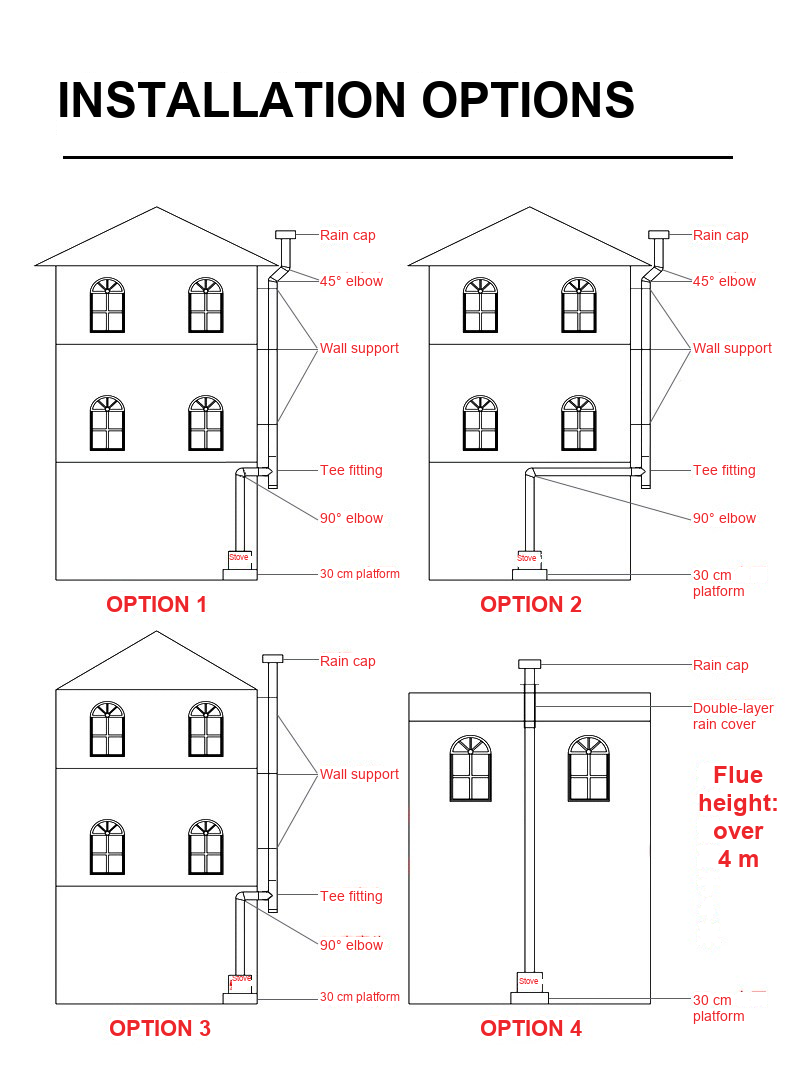
Start at the proposed stove position and trace the route to the rain cap. Look at where the pipe crosses a wall or ceiling, how it passes the eaves, and where the outside supports will sit. Bring a sketch and photographs to the site visit so your installer can work out the flue dimensions, clearances and access needed for the appliance you choose.
Tell the installer about kitchen extractor fans and other ventilation equipment, especially in a tightly sealed home. Exhaust equipment can depressurize a house and interfere with natural draft. Ask how the appliance will receive enough combustion air, and whether the proposed setup needs a dedicated air supply or other measures. The answer depends on the appliance and building. EPA’s remodeling guidance discusses this interaction between ventilation and combustion equipment.
Wood-burning fireplace, insert or stove: which type fits?
Product listings use the word “fireplace” for different designs. Identify the type of appliance you are comparing and the installation work it requires.
Scroll across the table to see all columns.
| Appliance type | What to discuss before choosing |
|---|---|
| Open-hearth wood-burning fireplace | Whether the main aim is enjoying an open fire, and how much useful room heat the particular design provides. |
| Freestanding wood stove | Where the appliance and flue will sit, including the space needed around them. |
| Wood-burning insert | Whether it is compatible with the existing fireplace opening and chimney system. |
| Enclosed built-in wood-burning fireplace | The enclosure, ventilation and access requirements in the exact model’s installation instructions. |
An insert needs more than an opening of the right dimensions. Compatibility with the existing fireplace matters, particularly with factory-built units. EPA’s appliance guide explains this distinction.
When measuring the room, include the hearth or floor protection and required distances from combustible materials. Use the selected model’s instructions and the installer’s assessment to establish those dimensions.
Browse the wood-burning fireplaces collection to compare available designs, then review the technical documents for the models on your shortlist.
Compare heat output, efficiency and emissions evidence
If useful room heating is a priority, look closely at enclosed heating appliances. An open hearth and an enclosed wood heater should not be compared on appearance alone; their heating performance can differ substantially.
You will also encounter terms such as secondary combustion and catalytic combustion. These describe approaches used to improve combustion and reduce emissions. Compare these features alongside the model’s tested efficiency, heat output and emissions results. EPA’s wood-burning appliance FAQ explains the technologies and the differences between appliance types.
Read the stove’s airflow diagram
In this cutaway, blue arrows trace incoming air through the rear and bottom inlets. The diagram also identifies secondary combustion ports and an airwash inlet above the glass. Airwash sends air down the inside of the glass, while the secondary ports introduce air higher in the firebox.
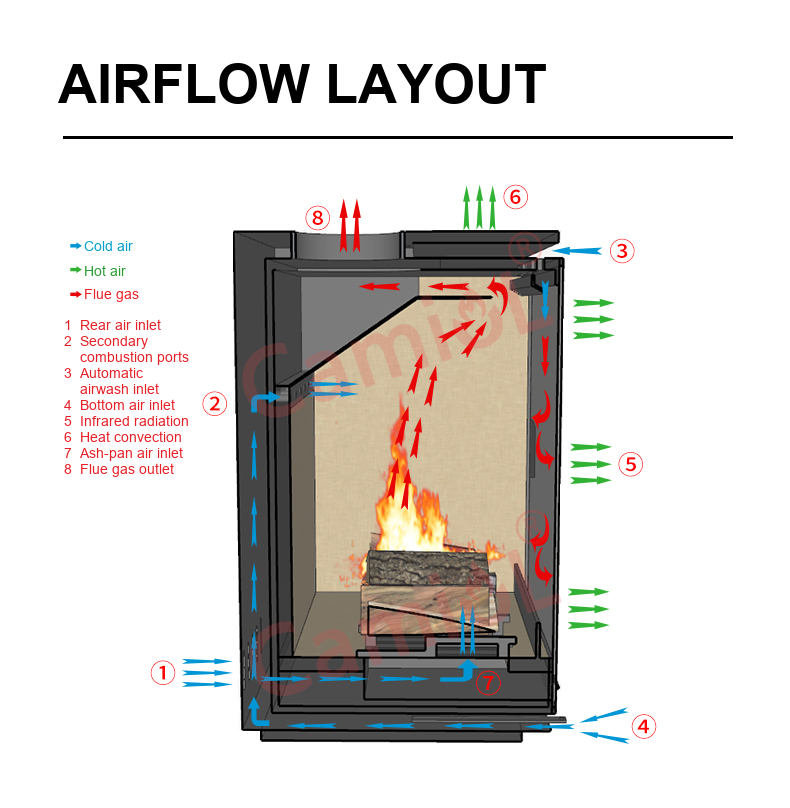
Red arrows follow combustion gases toward the top flue outlet. Green arrows show heat moving into the room, with convection above the stove and radiant heat at the front. When comparing models, use the airflow diagram to understand the air paths, then ask the supplier to show you the controls used during lighting and normal burning.
Request the exact model’s output specifications, efficiency information and supporting test documents. Check that any approval or certification being offered applies to that model and is relevant to where you live. Have the installer confirm local installation and use requirements before you order.
Choose cast iron or steel and a suitable fire view
Cast iron and steel are both worth considering. Compare the actual appliances, including their construction, weight, maintenance instructions and replacement parts. Review the model’s warm-up and heat-retention information alongside its weight, construction and servicing requirements.
For everyday ownership, practical details deserve a closer look. Ask how the door seals are replaced, how the glass is cleaned and whether internal parts can be obtained when needed. A showroom visit is a good opportunity to try the door handle and see how you would load the fire.
Then think about where you will sit. A single-sided fireplace may give you the view you want from the sofa. A two-sided design can suit a layout where the fire is seen from adjoining spaces. More glass should be evaluated for its view and placement, with heating performance checked separately.
Mark out the proposed installation on the floor. Check the walkways and furniture positions, and picture the room when the fire is unlit. The fireplace should feel comfortable within the space you live in.
Plan for firewood, maintenance and installation costs
Work out where you will buy firewood and where it will stay dry. EPA’s wood-burning guidance recommends wood with a moisture content below 20%, checked with a moisture meter before burning. Its storage advice is to keep wood outdoors, off the ground, with the top covered and the sides open. Follow the appliance’s fuel instructions as well. EPA’s wood-burning practices provide further advice.
Make room in the budget for maintenance. EPA recommends a professional inspection of the appliance, chimney and vent every year. Agree on a cleaning and servicing schedule with your installer that suits your setup and use.
Separate your budget into the appliance purchase, installation work and ongoing ownership. Request an itemized quotation showing whether chimney work, floor protection, the surround, ventilation provisions and commissioning are included, along with any necessary approvals. Establish which items remain your responsibility before comparing the totals.
See which chimney components are included
The accessory diagram breaks a wall-exit installation into its main parts. Straight flue sections form the vertical run. Elbows change the direction, and a tee fitting joins the side-entry pipe to the outside stack. Wall supports hold the external run, a trim plate finishes the wall opening, and a rain cap sits at the top.
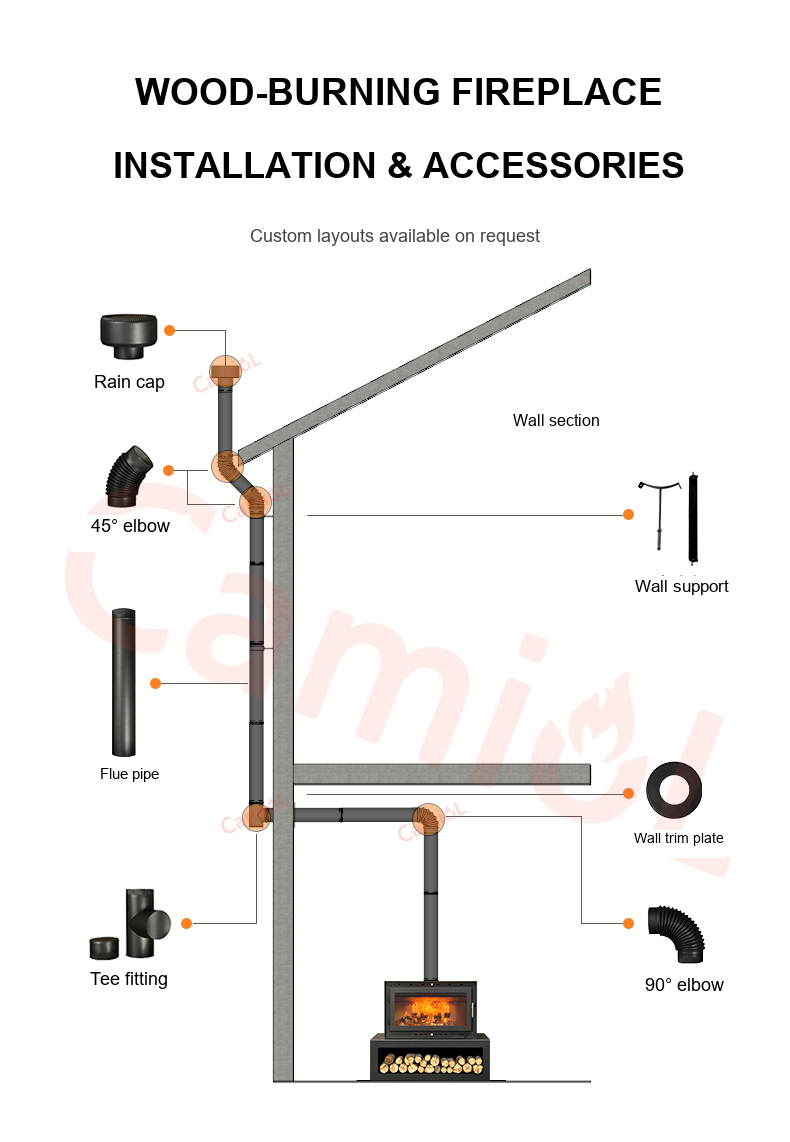
Use the drawing when discussing your installation quotation. Ask for the pipe sections, fittings and supports to be listed against the proposed route. That makes it easier to see what the price includes and which pieces are needed to connect the stove to the chimney termination.
Prepare your details before requesting a quote
Prepare a floor plan, room dimensions and photographs of the proposed location. Include details of any existing chimney, your current heating and ventilation systems, and the rooms you hope to warm.
Bring a few design references too. They help explain the proportions and viewing style you like. With the house details and your preferred appearance together, you and your installer can narrow the shortlist to models worth considering for your home.
Wood-burning fireplace FAQs
Can you install a wood-burning fireplace without an existing chimney?
It may be possible if a suitable new chimney system can be installed. An installer must assess the route, appliance compatibility, termination and local requirements before confirming that the project is feasible.
Can one wood-burning fireplace heat the whole house?
A single appliance may contribute to heating several rooms, depending on the house and heating arrangement. Assess the home’s heat loss and how heat will reach those rooms before relying on it as your main heat source.
Can a wood-burning insert fit any existing fireplace?
No. The opening, existing fireplace and chimney system must be compatible with the insert. For a factory-built fireplace, confirm that the proposed insert is specifically designed and tested for that unit. Check the manufacturer’s installation instructions.