

Do Bioethanol Fires Give Off Heat?
On this page
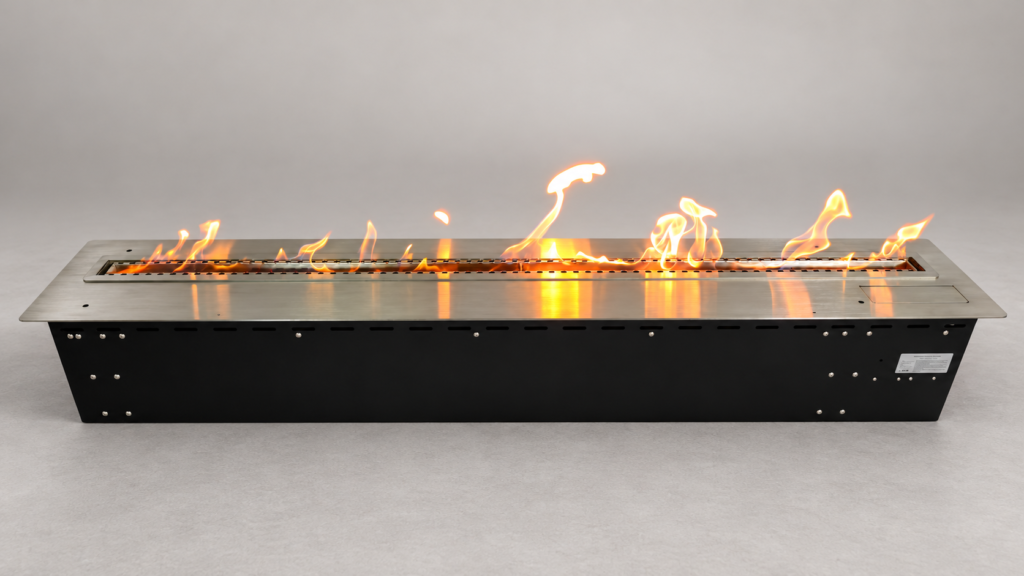
Yes. A bioethanol fire burns real fuel with a real flame, and with no chimney almost all of the heat it makes stays in the room. How much heat you get depends on how much fuel the burner uses, and for most homes that adds up to top-up warmth rather than a replacement for central heating. This guide shows how to check a fire’s heat output, whether it will warm your room and what it costs to run.
Do bioethanol fires give off heat?
They do, because the flame is real. Burning bioethanol releases the energy stored in the fuel, roughly 5.9 kWh for every litre, and none of it is lost up a flue. That is the main difference from an electric flame-effect fire, where the flame is a picture and any heat comes from a separate heater.
The honest limit is quantity. The National Energy Foundation puts most bioethanol fires at around 2–3 kW, about the same as a two-bar electric fire. DRU, which makes bioethanol fires, says plainly that they do not produce enough heat to be a primary heat source, although they are very good at making a room feel warmer. That is the right expectation to start with.
Are bioethanol fires warm?
Warm to sit by, and warm enough to take the chill off a room. Close to the fire you feel radiant heat from the flame straight away. The room itself warms more slowly, as the air around the fire heats up and circulates.
Real measurements show the scale. In a test by Planika, a manufacturer, a 2.5 kW freestanding fire raised the temperature of a flat’s living room from 21.2 °C to 23 °C in about an hour. A Homebuilding reviewer running a 2.46 kW bioethanol stove with the central heating off found it took the chill off the air, and their Hive thermostat recorded the room getting warmer, though they expected it to struggle in a much larger room.
Two things work against the warmth. The room needs ventilation while the fire burns, and fresh air carries some heat away. And a draughty room loses heat faster than a small fire can replace it.
How much heat does a bioethanol fire produce?
It depends almost entirely on the burner. Direct Fireplaces puts typical models at 1–3 kW. EcoSmart’s single burners run from about 1.7 kW for a small round burner to 6 kW for its largest, and multi-burner built-in installations reach 8.8–13 kW. The fireplace shell around the burner makes little difference.
There is a simple way to check any figure you are given. A fire cannot release more heat than its fuel contains, so its maximum output is roughly its fuel use in litres per hour multiplied by 5.9. A burner that takes about four hours to burn one litre uses 0.25 litres an hour, which works out at about 1.5 kW. If the same fire is advertised at 3 kW, the numbers do not add up.
In practice the gap can be wider still. A peer-reviewed study in ACS Omega tested eight bioethanol burners with two fuels, using a method based on the EN 16647 standard. On average, the burners delivered only about 41–62% of the heat output their manufacturers declared, and output varied by up to 19% between fuels. So treat a kW figure as a ceiling, and look for the fuel use alongside it.
Here are the reference fuel-consumption figures for the listed linear SXRX-L-005 configurations in our SXRX Smart range, so you can work the heat out yourself:
Scroll across the table to see all columns.
| Model | Typical fuel use (L/h) | Heat released by that fuel (kW, calculated) |
|---|---|---|
| RX500 | 0.5 | about 3.0 |
| RX600 | 0.7 | about 4.1 |
| RX900 | 1.0 | about 5.9 |
| RX1200 | 1.4 | about 8.3 |
| RX1500 | 1.8 | about 10.6 |
| RX1800 | 2.16 | about 12.7 |
| RX2400 | 3.0 | about 17.7 |
The kW column is the energy in that typical fuel use, calculated at 5.9 kWh per litre, not a measured output; a higher or lower flame setting changes both. It also shows why the larger models need large, well-ventilated rooms: more fuel per hour means more heat, but also more water vapour and carbon dioxide in the room.
Do bioethanol fires heat a room?
They can warm the room they are in by a few degrees, which is useful on a cool evening or between heating cycles. They are not designed to heat a whole house.
Whether one will warm your room depends on three things. The first is the room’s size and the minimum room volume in the model’s manual; as a manufacturer rule of thumb, EcoSmart asks for at least 5.7 m³ of room for every 1,000 BTU/h of burner output, which is roughly 19.5 m³ per kW. The second is how much heat the room needs. Homebuilding notes that a 5 m × 5 m room in a new-build house needs around 1.4 kW to feel warm on a typical winter’s day, while an older, draughty room needs far more. The third is insulation. Smart Fire’s example is a 2 kW fire that feels gloriously warm in a well-insulated 15 m² study but is barely noticeable in a draughty 40 m² open-plan kitchen.
So choose the fire for the room and the look first, check the manual’s room size and ventilation, and count any heat as a bonus. Our guide to whether bioethanol fires need a flue explains room size and ventilation in more detail.
Are bioethanol fires expensive to run?
As heating, yes. As an occasional real fire, many people find the cost reasonable. Work it out with two numbers:
- Cost per hour = fuel use in litres per hour × your price per litre.
- Cost per kWh of heat = price per litre ÷ about 5.9.
Fuel prices vary widely. ImaginFires quotes £2.50–£7.00 per litre depending on where you buy, and on 1 November 2026 its 12-litre pack was on sale at £46.99, about £3.92 a litre. At £4 a litre, a small manual burner using 0.25 litres an hour costs about £1 an hour. Three-hour evenings, three times a week, come to about £39 a month. A large built-in burner using 1.4 litres an hour costs about £5.60 an hour at the same price.
Per unit of heat, £4 a litre works out at about 68p per kWh, and £6 a litre at about £1.02. Under Ofgem’s price cap for October to December 2026, electricity costs 26.32p per kWh and mains gas 7.97p per kWh. Bioethanol heat therefore costs roughly two and a half to four times as much as electricity, and eight to thirteen times as much as gas. Smart burners also draw electricity for their pump, ignition and controls, and the draw varies while they run: our SXKT 1200 mm model, for example, has a maximum electrical power specification of 1,250 W; its electrical power varies with the setting, so that maximum is not a constant load. Manual burners use none.
What you pay for is the flame and the freedom to install it without a chimney, gas line or building work, not cheap heat. Turning the flame down is the easiest saving, because the fuel lasts longer.
Frequently asked questions
Can a bioethanol fire replace central heating? No. Even the larger models are supplementary heat, and running one for hours every day would be expensive and would need a large, well-ventilated room.
Are bioethanol fires 100% efficient? Almost all the heat from the fuel stays in the room because there is no flue, which is why retailers call them 100% efficient. That does not mean a fire delivers its advertised kW; check the fuel use.
Do bioethanol fires need electricity? Manual burners do not. Smart burners, including SXKT Smart and SXRX Smart, need a power supply for their pump, ignition and controls.
Related reading: Do bioethanol fires need a flue? · Are bioethanol fires safe? · Can you put a TV above a bioethanol fireplace?
Sources
- National Energy Foundation – Bioethanol fires
- DRU – Frequently asked questions about bioethanol fires
- Planika – Do ethanol fireplaces give off heat?
- Homebuilding – Arada Hamlet Solution 5 review
- Homebuilding – Bioethanol fireplaces and stoves
- Direct Fireplaces – How much heat do bioethanol fires produce?
- EcoSmart Fire – Heat output and room sizing guide
- Real operating parameters of bioethanol burners, ACS Omega 2020 (PMC7658952)
- Smart Fire – Bioethanol fireplace heat output
- ImaginFires – Bioethanol fireplace running costs
- ImaginFires – 12-pack fuel
- Ofgem – Price cap 1 October to 31 December 2026
- SXFireplace – Bioethanol fireplaces