
Can You Put a TV Above a Bioethanol Fireplace?
On this page
Yes, in many cases, as long as the wall above the fire stays within what both the fireplace and the TV allow. A bioethanol fire is one of the easier fires to put under a TV: there is no smoke or soot, and it gives off less radiant heat than a wood-burning stove. But it has no flue, so its hot air rises straight up the wall, exactly where the TV would go. Treat it as a heat question first and a design question second.
What the TV can take
TV makers set an operating temperature limit, and it is lower than most people expect. Samsung says its TVs should never exceed 104 °F (40 °C), does not recommend mounting a TV over a fireplace, and tells owners to light the fire and check the temperature before mounting anything. Other brands publish their own limits, usually as an operating temperature in the manual, so check yours. Heat damage builds up over time and may not be covered by the TV warranty.
How much heat does a bioethanol fire give out?
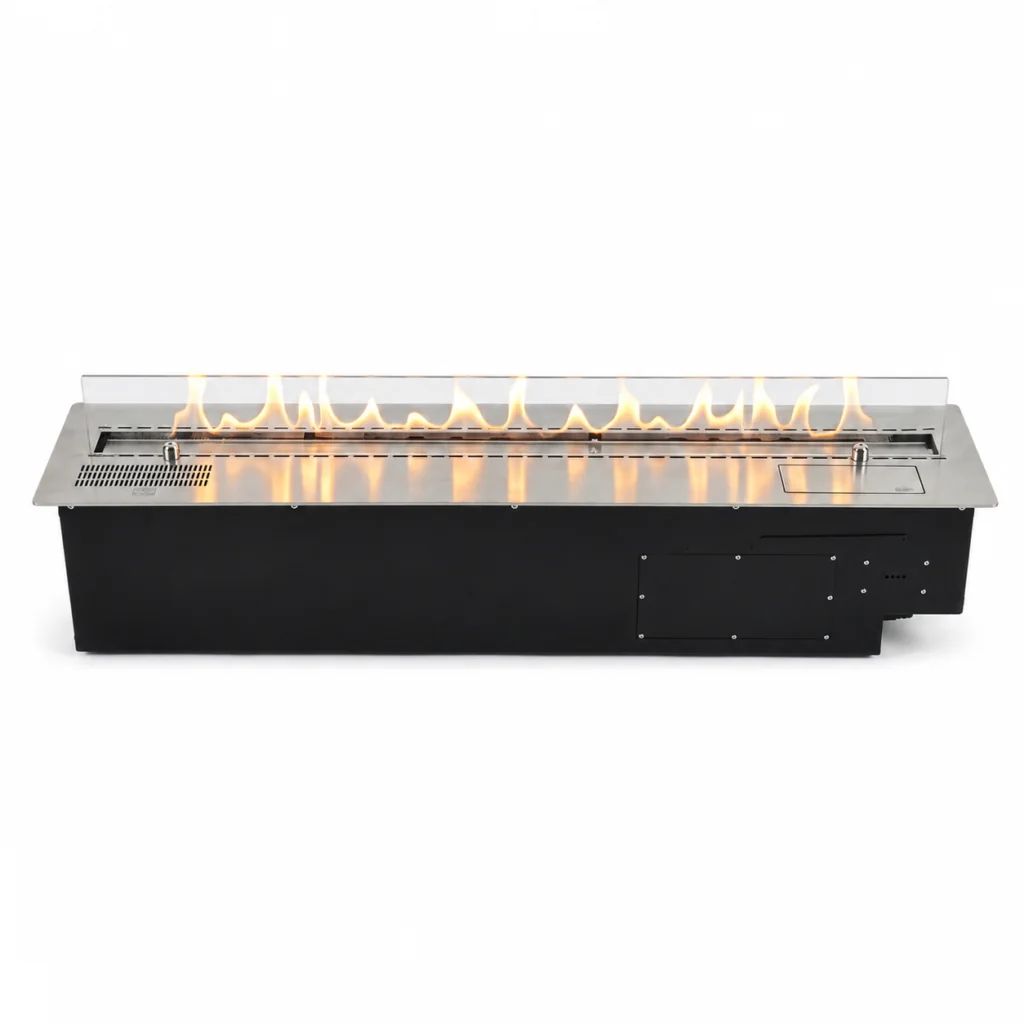
Enough to matter for a TV. The National Energy Foundation puts most bioethanol fires at around 2–3 kW, about the same as a two-bar electric fire, which makes them supplementary heating rather than a main heat source. Larger linear burners go higher: EcoSmart, for example, rates its XL900 burner at 15,000 BTU/h, about 4.4 kW.
A quick way to estimate any burner is its fuel use. Each litre of bioethanol releases roughly 5.9 kWh of heat, so a burner using half a litre an hour is giving off about 3 kW. With no chimney, almost all of it stays in the room, and the hottest air goes straight up. Longer burners and higher flame settings use more fuel and push more heat towards the wall above.
TV above a bioethanol fireplace: why the distances differ
Search for a safe gap and you will find numbers from 300 mm to a metre. They are not contradictory; each belongs to a particular product, measured from a particular point, with a particular heat shield. Mixing them up is the mistake.
Scroll across the table to see all columns.
| Brand and arrangement | Minimum gap to the TV | Measured from | Condition |
|---|---|---|---|
| EcoSmart Fire (guide) | 300 mm | Fireplace opening | TV recessed in a niche, or set back from the flame line; or a non-combustible mantel as a heat shield |
| ImaginFires (FAQ) | 18 in (about 460 mm), ideally | Top of the fire to bottom of the TV | Only above a fire with a closed top |
| IGNIS wall-mounted fires | 30 in (about 760 mm) | Top of the burner to bottom of the TV | That brand’s wall-mounted models |
| Planika fireplace inserts | 900 mm | Top edge of the fireplace | TV in a recess at least 100 mm deep, or above a non-combustible shelf projecting at least 100 mm |
| SXFireplace SXKT smart fireplaces | 500–700 mm unobstructed | Top panel to any overhead surface | 100 mm ceramic wool in the panel below the TV; difficult-to-ignite finishes |
Use the figure in your own model’s installation drawing, and then prove it with a temperature test. A gap borrowed from another brand’s page tells you nothing about your fire.
The fireplace’s own clearances come first
The fireplace manual and drawing set the minimum distances, and the TV position has to fit around them. For our SXKT smart fireplaces, the published installation guidance asks for 500–700 mm of unobstructed vertical clearance between the fireplace’s top panel and any overhead surface. It keeps combustible decoration outside a 500 mm zone around the platform and asks that no hanging combustible items, such as curtains, drapes or hanging decorations, be suspended within 3 m above the panel. A TV is not covered by that rule; it is covered by the TV-wall arrangement. For a TV wall, the guidance specifies 100 mm-thick insulating ceramic wool inside the decorative panel below the television, with heat-resistant, difficult-to-ignite finishes, and notes that insulation does not reduce the required clearance.
The startup phase matters too. In one KT1500 installation, the owner reported startup flames reaching the plasterboard above the fireplace. If flames ever touch an overhead surface, stop using the fireplace and arrange a technical review before lighting it again.
Bioethanol fireplace media wall: choosing the setup
A media wall works best when the fireplace and the wall are planned as one system, not when a burner is dropped into a finished unit. Planika, for example, recommends its fireplaces with a dedicated casing and deflector for TV walls, because they keep hot air away from the electronics above; without the deflector, it rules out mounting equipment on the wall above. A loose burner tray built into an MDF or timber cabinet is a different thing altogether.
When you compare options, ask three questions. Does the manufacturer approve this model for use below a TV, with a drawing to prove it? Which materials must be non-combustible around the opening and in the recess or shelf above it? And where does air come in and heat go out? For SXKT built-in models, that last answer includes the bottom air inlet of 60 cm² per metre of fireplace length, which has to be designed into the frame from the start. The room still needs normal ventilation as well; our guide to whether bioethanol fires need a flue explains why.
Bioethanol fireplace under a TV: installation steps
Build the wall and fit the fireplace first, then decide the final TV height. Run the fire at its highest setting for a long, normal session and measure the temperature where the TV’s lower edge and back panel would sit. If it gets close to the TV maker’s limit, do not mount the TV there: raise it, set it into a ventilated, insulated niche designed with the installer, or move it to another wall. A non-combustible shelf or mantel can deflect some heat, but it does not replace the clearance the fireplace requires.
Plan the cables at the framing stage. Chesneys advises routing them through the media wall so they never pass near the burner or above the fire opening, and the wall behind the TV must be able to carry its weight on proper fixings.
Think about the viewing height as well. A TV above a fireplace usually ends up well above seated eye level; Samsung suggests a mount that tilts down to spare your neck.
When to choose another wall
If the clearance in the drawing, a TV position that passes the temperature test and a comfortable viewing height cannot all fit on the wall, choose another location for the TV or a smaller burner. A fireplace and a TV on adjacent walls often works better than a stacked media wall.
For the opening, ventilation and power details of SXKT models, see our SXKT installation guide. For any other model, ask for its current installation drawing through Technical Resources before the wall is built.
Frequently asked questions
How high above a bioethanol fireplace should a TV be? At least the clearance in your model’s installation drawing; for SXKT smart fireplaces that is 500–700 mm from the top panel to the overhead surface. Then confirm with a temperature test that the TV position stays within the TV maker’s limit.
Will a bioethanol fireplace damage my TV? It can if the TV sits in the rising heat. Samsung sets a 40 °C limit for its TVs and does not recommend mounting them over fireplaces.
Does insulation behind the panel let me mount the TV lower? No. Insulation protects the wall build; it does not reduce the clearance the fireplace requires.
Related reading: Do bioethanol fires need a flue? · Are bioethanol fires safe?
Sources
- Samsung US – Things to consider before mounting your Samsung TV to a wall
- National Energy Foundation – Bioethanol fires
- EcoSmart Fire – XL900 burner
- EcoSmart Fire – How to install a TV above a fireplace
- ImaginFires – Can you put a TV above a bioethanol fireplace?
- IGNIS – Mounting a TV over a wall-mounted ethanol fireplace
- Planika – Media wall: within reach of the fireplace
- Chesneys – Can I put a TV above my fireplace?
- SXFireplace – SXKT installation guide
- SXFireplace – Bioethanol fireplaces