

Are Bioethanol Fires Safe?
On this page
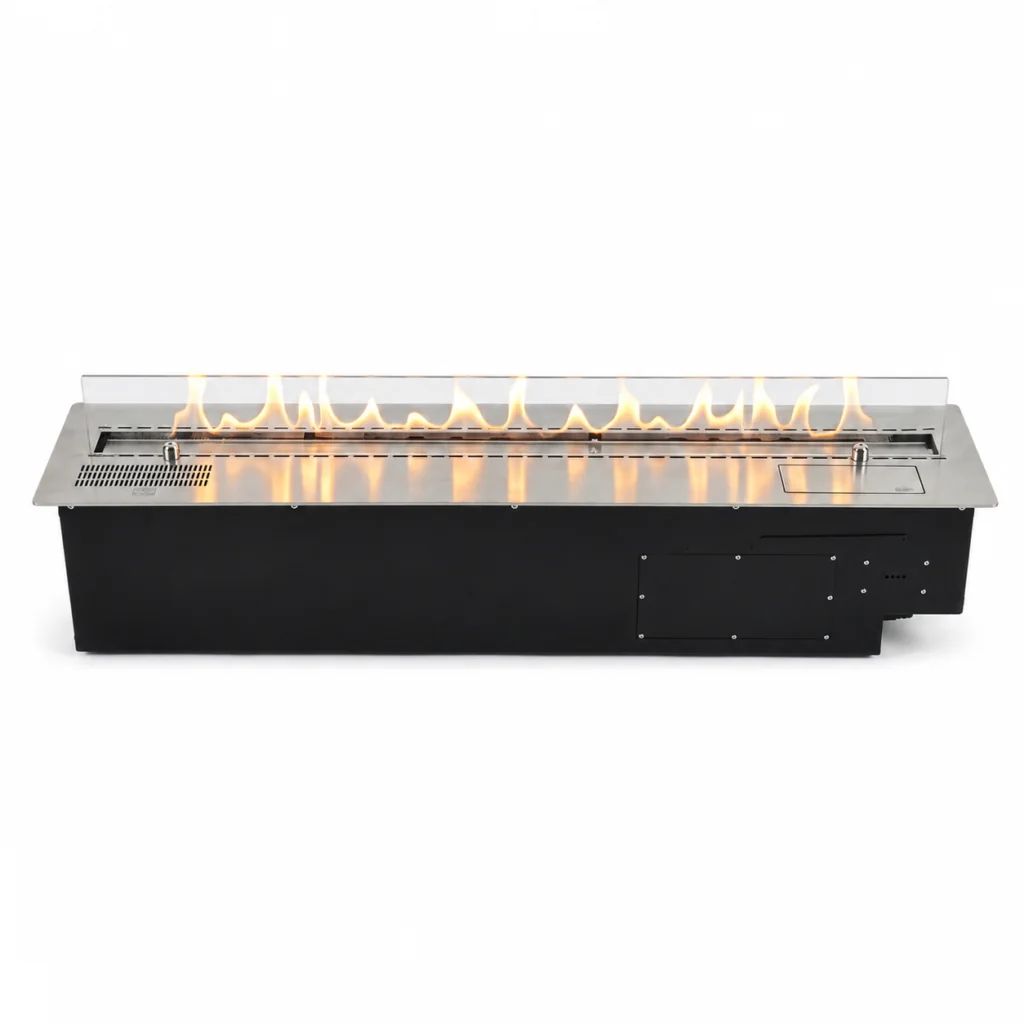
A bioethanol fire can be used safely when it is the right appliance for the room, installed to its drawing and run to its manual. It is still an open flame burning a highly flammable liquid, and it releases its combustion products into the room. So the honest answer is “yes, with conditions”, and most of those conditions are about how the fire is used rather than how it looks.
Where accidents actually happen
RoSPA says the highest risk comes when refuelling. Fuel poured into a burner that is still lit or hot can ignite, and RoSPA warns that a burner can be hot enough to light the fuel even when no flame is visible. Health Canada calls the result flame jetting: the vapour ignites and flame shoots back towards the person filling, faster than they can step away. Bioethanol can also burn with a flame that is hard to see when little fuel is left, so a burner that looks out may not be.
The scale is not trivial. In December 2024 the US Consumer Product Safety Commission linked fire pits that burn pooled alcohol to two deaths and at least 60 injuries since 2019, from two hazards: pool fires, where burning fuel spreads across a spill, and flame jetting during refilling. Most were small tabletop units filled by hand, which is why the refuelling method matters more than the size of the fire.
The other common causes are simpler: the wrong fuel, a flame too close to curtains or furniture, and a fire left burning in an empty room.
Rules that apply to every model
Refuel only when the fire is fully out and the burner has cooled completely. Hereford & Worcester Fire and Rescue Service advises waiting at least 15 minutes. For SXKT, the published manual also requires complete flame extinction and a burner temperature below 40°C before filling; elapsed time does not replace those checks. For other models, follow the supplied manual, including any longer cooling period or temperature limit. Wipe up any spill and let it dry before relighting.
Use only the fuel the manual specifies. Do not use gel fuel, methanol, rubbing alcohol or a fuel with unknown additives. For SXKT Smart and SXRX Smart this means 95% vol bioethanol.
Place a freestanding fire on a flat, stable, non-combustible surface, keep the clearances on the model drawing, and keep curtains, cushions and decorations out of that zone. Never move the fire while it is lit or still hot.
Never leave a burning fire unattended, and make sure it is out before you leave the room or go to bed. Keep children and pets away from both the flame and the fuel.
Store fuel in its original container with the lid tight, somewhere cool and dry, away from sunlight, heat and naked flames.
Is bioethanol safe indoors?
Only in an appliance made for indoor use, in a room that suits it. RoSPA’s rules are short: use an indoor-rated fire, keep the room well ventilated, never use it in a small or poorly ventilated space, and fit a carbon monoxide alarm. Some bioethanol fires and fire pots are made for outdoor use only, so check the product before it comes inside.
The harder question is indoor air. In chamber tests by Fraunhofer WKI, unvented ethanol fireplaces pushed carbon dioxide and nitrogen dioxide to or above indoor-air guideline values and released large numbers of fine and ultrafine particles, whatever fuel was used. Fraunhofer WKI goes further than most and advises using ethanol fireplaces outdoors only. A 2026 study with minimal ventilation found formaldehyde and nitrogen dioxide frequently above WHO guideline values, with results that depended on the burner design and the fuel.
We think you should know that before you buy. If you choose an indoor bioethanol fire, size it to the room, use only the specified fuel, ventilate whenever it burns, and treat it as an occasional decorative fire rather than all-evening heating in a closed room. Our guide to whether bioethanol fires need a flue covers room size and ventilation in detail.
Do bioethanol fires smell?
A little, and the reasons are usually easy to trace. A new burner often gives off a light smell during its first burns while it cures. Dust, building debris or cleaning products that settle in the burner, and old fuel left in the reservoir, can all smell when heated; EcoSmart’s advice is a full clean and a refill with fresh fuel. Many owners also notice a faint smell at the moment the flame goes out.
Fuel quality matters most. Bioethanol is denatured with additives so it cannot be drunk, and the German Environment Agency notes that denaturants, dyes and other additives make complete combustion hard to achieve. A cheaper fuel with more of them tends to smell more. If a strong smell persists, stop using the fire, ventilate the room and check the fuel against the manual.
One point matters more than the smell itself: carbon monoxide has no smell at all, as the UK Health Security Agency points out. A fire that smells clean is not proof the air is safe, which is why the alarm matters.
Are bioethanol fires bad for your health?
They can affect your health if they are used in the wrong room or for too long. RoSPA states that bioethanol fires produce carbon monoxide while burning, and the research above shows nitrogen dioxide, formaldehyde and fine particles rising indoors, especially when ventilation is poor. These studies describe test chambers and particular burners and fuels, not every home or every fireplace, but they all point the same way: the less fresh air, the worse the air you breathe.
Keep the risk low with a model sized for the room, ventilation whenever it burns, the specified fuel only, and shorter, occasional use. Learn the signs of carbon monoxide poisoning, which RoSPA lists as headaches, dizziness, nausea, breathlessness and feeling faint or confused. If they appear, ventilate, get everyone out and seek medical help.
How to light a bioethanol fireplace
With a manual burner, the user does every step, so follow the order:
- Check the fire is fully out and the burner is completely cold. If it has just burned, wait at least 15 minutes, or longer if the manual says so.
- Fill with the specified fuel to the level in the manual, never above it, using an approved small container. Put the fuel bottle away from the fire.
- Wipe up any spill with a damp cloth and let the surface dry.
- Light it with an extended lighter or extra-long match, keeping your hands, hair and sleeves back. Do not drop matches into the burner.
- To put it out, close the lid or slide the shutter with the supplied tool. Do not blow it out, and never use water.
A smart burner works differently. Fuel is pumped from a sealed tank and lit electronically, so nobody pours fuel near a flame. On SXRX Smart, for example, the published RX manual lists dual-level monitoring, low-fuel shutdown, tilt protection, a child lock, fault self-diagnosis with voice prompts and remote on/off at approximately 5–10 m. Where the supplied configuration and its manual support temperature-protection recovery, the appliance may restart automatically after the temperature returns to the permitted range; a protective pause is not completed shutdown or permission to refuel. Thermostat and timer functions are standard for the current SXKT-001; confirm the functions and controls for the ordered configuration. Follow the start, refill and shutdown procedure in that model’s manual; the manual-burner steps above do not transfer to it. These features reduce some risks, but they do not remove the need for supervision, clearances and ventilation.
If the fire gets out of control
If the fire cannot be put out with its own extinguishing mechanism, move away, close the doors behind you if it is safe, and call 999. Do not try to fight it or move the appliance, and do not use water, which spreads the flames. RoSPA’s advice for burns is to cool the area under cool running water for at least 20 minutes and get medical help if the burn is serious.
Documents to ask for
Ask the supplier for the manual, installation drawing and safety documents for your exact model and destination country, and ask which product standard it was assessed against. In the UK, RoSPA advises looking for BS EN 16647-1:2025, which replaced the 2015 edition for manually operated decorative ethanol fireplaces up to 4.5 kW. In the United States and Canada, ANSI/CAN/UL/ULC 1370:2024 covers fixed unvented alcohol-fuel decorative appliances up to 0.95 litres of fuel an hour. A loose burner tray sold on its own is a component, not a finished appliance; the German standards body DIN notes that such parts cannot meet the standard alone. SXFireplace supplies documents by model and destination on request.
Frequently asked questions
Are bioethanol fires safe in a flat? They can be, if the room meets the model’s minimum volume and ventilation requirements and the building rules allow an open-flame appliance.
Is bioethanol fuel safe to store at home? Yes, in its original closed container, kept cool and dry, away from heat and flames and out of reach of children and pets.
How long should a bioethanol fire cool before refuelling? At least 15 minutes, as UK fire services advise, and until the flame is fully extinguished and the burner is cold. For SXKT, also confirm that the temperature is below 40°C before filling; follow the specific model manual if it requires longer or different checks.
Related reading: Do bioethanol fires need a flue? · Can you put a TV above a bioethanol fireplace?
Sources
- RoSPA – Bioethanol fires
- Greater Manchester Fire and Rescue Service – Bioethanol burners
- Hereford & Worcester Fire and Rescue Service
- Warwickshire County Council – Safety advice for bio-ethanol burners
- UKHSA – Carbon monoxide: general information
- US CPSC – Consumer Alert (Dec 2024)
- Health Canada – Flame-jetting risk
- Fraunhofer WKI – Ethanol fireplaces
- Schripp et al. 2014 (PubMed 24517295)
- Vicente et al. 2026 (PubMed 41849930)
- German Environment Agency (2016)
- EcoSmart Fire – Burner odour troubleshooting
- EN 16647-1:2025 scope
- DIN EN 16647:2016 overview
- ANSI/CAN/UL/ULC 1370:2024 scope
- SXFireplace – Fuel requirements