

Do Bioethanol Fires Need a Flue?
On this page
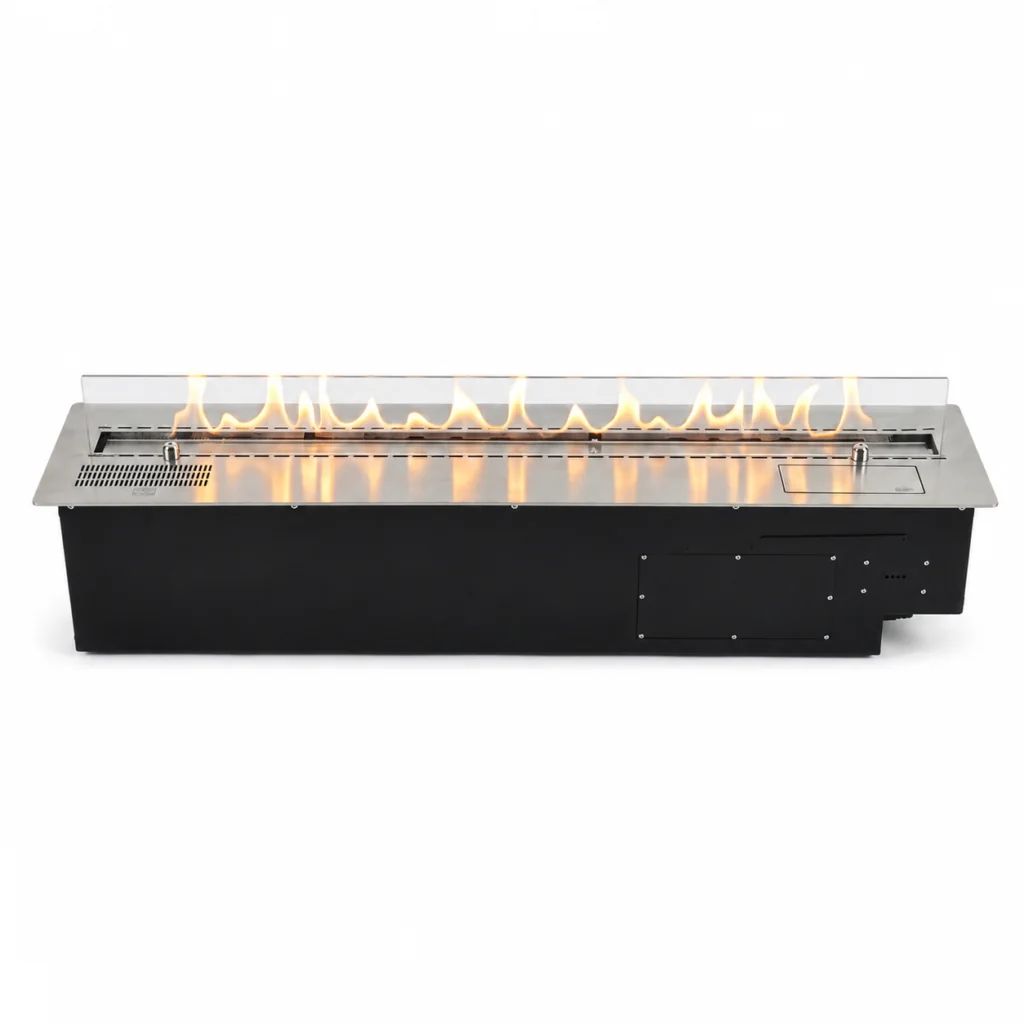
No. A bioethanol fire does not need a flue, chimney or outside vent, which is why one can go into a flat, a new stud wall or a media wall. It does need ventilation, because everything the flame produces stays in the room. Most installation mistakes come from hearing the first half of that answer and not the second.
Why a bioethanol fire has no flue
A bioethanol burner is not connected to a flue. The fuel burns at the burner and the combustion products are released into the room, so there is nothing to build above the fire and no heat lost up a chimney. Each litre of bioethanol releases roughly 5.9 kWh of heat, and almost all of it stays where you are sitting.
Not needing a flue does not, by itself, mean that an installation is exempt from building regulations. Check the requirements for the specific installation and jurisdiction with local building control. A decorative hood or chimney breast around a bioethanol fire is a design choice, not a flue.
Do bioethanol fires need ventilation?
Yes. Greater Manchester Fire and Rescue Service says a bioethanol fire used indoors should always be in a well-ventilated room, and RoSPA says never to use one in a small or poorly ventilated space.
The reason is what the flame releases. Burning ethanol uses oxygen from the room and gives off carbon dioxide and water vapour, and laboratory tests show that is not the whole picture. Researchers at Fraunhofer WKI burned eight fuels in four unvented ethanol fireplaces in a 48 m³ chamber, ventilated to the manufacturers’ recommendations: carbon dioxide and nitrogen dioxide often came close to or above indoor-air guideline values, fuel additives turned up in the air, and every fireplace was a strong source of fine and ultrafine particles (Schripp et al., Environmental Science & Technology, 2014). A 2026 study in the Journal of Hazardous Materials tested two fuels and two burner designs with minimal ventilation and found formaldehyde and nitrogen dioxide frequently above WHO guideline values; results changed with the burner, the fuel and how much fuel was loaded.
There is a building side to it as well. The water vapour has to go somewhere, and NEF notes that on cold surfaces such as single glazing or uninsulated walls it can condense and raise the risk of mould. Fresh air carries it away.
Do bioethanol fires produce carbon monoxide?
Yes, they can. RoSPA states that bioethanol fires produce carbon monoxide while burning, and Warwickshire County Council’s fire safety advice says the same. The UK Health Security Agency explains that carbon monoxide forms when fuel burns without enough oxygen, and that it is colourless, tasteless and odourless. A fire that smells clean is therefore no proof that the air is. You will find pages online claiming bioethanol produces no carbon monoxide at all; they are wrong.
The practical answer is an alarm. Fit a carbon monoxide alarm in the room with the fire; Warwickshire recommends battery alarms that meet BS EN 50291 and carry the BSI Kitemark, on each level of the home and near sleeping areas, tested regularly. Learn the warning signs too: headaches, dizziness, nausea, breathlessness and confusion. If anyone feels them while the fire is lit, ventilate the room, get out and seek medical help.
What is a ventless ethanol fireplace?
“Ventless” is the American word for the same appliance: an alcohol-fuelled fireplace that releases its combustion products into the room rather than through a vent. The word describes where the gases go. It does not mean the fireplace has no emissions, and it does not mean the room needs no fresh air.
What separates one ventless fireplace from another is the standard it was tested against. In the UK, RoSPA advises looking for BS EN 16647-1:2025, which covers manually operated decorative ethanol fireplaces for domestic use up to 4.5 kW. In the United States and Canada, ANSI/CAN/UL/ULC 1370:2024 treats these appliances as decorative rather than a main heat source, caps fuel input at 0.95 litres an hour and excludes bathrooms and rooms used for sleeping. EcoSmart quotes UL’s rule of thumb for small rooms: if there is less than 5.7 m³ of air space for every 1,000 BTU/h of burner rating, keep a door to the next room open or open a window at least 25 mm. Ask which standard, and which edition, your model was assessed against.
Bioethanol fireplace ventilation: how to plan it
Use the exact model’s manual to confirm the required room volume and ventilation for the burner and installation. Do not treat a generic room-volume figure as a substitute for those model-specific requirements. Avoid bedrooms and bathrooms unless the manual explicitly allows them.
Then think of ventilation in two separate parts. The first is the room: a normal supply of fresh air while the fire burns. An older, draughty house may already have it. In a modern airtight home, open a window slightly or run the mechanical ventilation while the fire is lit, and never cover existing vents or air bricks.
The second is the appliance’s own air path. Built-in smart burners such as the SXKT series need a lower or bottom air inlet connected to the space beneath the unit; the published SXKT reference is a nominal opening of 60 cm² per metre of fireplace length. That inlet supports internal cooling and combustion airflow. It does not replace room ventilation, and room ventilation does not replace it.
One more caution: an extractor fan or cooker hood nearby can change the airflow around the flame, so have any extraction in the same space assessed by a professional.
A short planning check
Before ordering, confirm four things for the exact model: the minimum room volume in its manual, how fresh air will reach the room while the fire burns, whether the design includes the bottom air inlet the drawing requires, and whether your building, landlord or local rules restrict unvented appliances. Then add a carbon monoxide alarm to the shopping list.
If you are planning a built-in installation, our ethanol fireplace installation guide and the SXRX and SXKT bottom-air-inlet guide cover the opening, support and airflow details. For the drawing and manual of a specific model, request them through Technical Resources.
Frequently asked questions
Can I install a bioethanol fire in a flat with no chimney? Often yes, because no flue is needed. Check the minimum room volume for the burner size, how the flat is ventilated and any building or tenancy rules first.
Do I need a carbon monoxide alarm with a bioethanol fire? Yes. RoSPA, Greater Manchester Fire and Rescue Service and Warwickshire County Council all recommend one in the room.
Do bioethanol fires need Building Regulations approval? Not needing a flue does not, by itself, mean that an installation is exempt from building regulations. Check the requirements for the specific installation and jurisdiction with local building control; landlords or building managers may also have requirements.
Related reading: Are bioethanol fires safe? · Can you put a TV above a bioethanol fireplace?
Sources
- RoSPA – Bioethanol fires
- Greater Manchester Fire and Rescue Service – Bioethanol burners
- Warwickshire County Council – Safety advice for bio-ethanol burners
- UKHSA – Carbon monoxide: general information
- National Energy Foundation – Bioethanol fires
- Schripp et al. 2014 (PubMed 24517295)
- Vicente et al. 2026 (PubMed 41849930)
- EcoSmart Fire – Clearance and ventilation requirements
- EN 16647-1:2025 scope (Standard Norge)
- ANSI/CAN/UL/ULC 1370:2024 scope (Standards Council of Canada)
- SXFireplace – SXKT installation guide